12 Mandatory Fields Every UK VAT Invoice Must Show
If you’re VAT-registered and the sale is taxable in the UK, yes: you must issue a VAT invoice showing VAT separately, at 20% unless a reduced or zero rate applies. If the place of supply is outside the UK, you don’t charge UK VAT at all, and you note the reason (reverse charge or outside scope) on the invoice instead. Either way, that invoice should be issued promptly following the time of supply, typically within a month.
TL;DR:
- VAT-registered businesses must issue full VAT invoices for standard- and reduced-rated supplies to enable their customers to reclaim input tax, unless the sale qualifies for simplified or retail exceptions.
- Invoices must include a unique sequential number, business and customer details, description, quantity, unit price, VAT rate, and total VAT charged, with specific references for margin schemes or reverse charge transactions.
- The correct VAT rate applies depending on the product or service, with 20% standard, 5% reduced, 0% zero rate, and exempt categories, and VAT must be calculated on after-discount prices.
- For cross-border B2B sales outside the UK, no UK VAT is charged; instead, you must note reverse charge, ensuring the customer accounts for VAT in their country and records their VAT registration number.
- Proper record-keeping, electronic invoicing, and consistent formatting are critical, especially with upcoming mandatory e-invoicing changes set for 2029, and automated validation reduces common compliance errors.
Table of Contents
- VAT on Invoices UK: Who Has to Issue One, and When
- The Full VAT Invoice Checklist: Every Mandatory Field
- Calculating VAT on Invoices: Rates, Zero-Rated vs. Exempt
- Selling Overseas: Place of Supply and the Reverse Charge
- Simplified Invoices, Self-Billing, and Other Special Cases
- Time of Supply: Why Timing Decides Which VAT Return You’re On
- Record-Keeping, Making Tax Digital, and the 2029 E-Invoicing Shift
- Common VAT Invoice Mistakes and a Quick Compliance Check
- An Invoicing Product Team’s Take on VAT Compliance
- Create Compliant VAT Invoices Without the Guesswork
- Sources
VAT on Invoices UK: Who Has to Issue One, and When
A VAT invoice isn’t just any invoice with a total on it. It’s a document that carries specific legal particulars set out in Regulation 14 of the VAT Regulations 1995, and it’s what lets your VAT-registered customer reclaim the input tax they’ve just paid you.
If you’re VAT-registered and you sell standard-rated or reduced-rated goods or services to another VAT-registered business, you’re generally required to issue one. Sole traders, partnerships, and limited companies all face the same obligation once registered. Miss it, and your customer has no paper trail to reclaim their input tax.
There are exceptions worth knowing:
- Retail exception: shops and other retail-style sellers can skip a full VAT invoice unless the customer specifically asks for one.
- Simplified invoices: for supplies of £250 or less (including VAT), you can drop several fields and still be compliant.
- Self-billing: in some B2B arrangements, the customer issues the invoice on your behalf, with your agreement and under specific conditions.
The Full VAT Invoice Checklist: Every Mandatory Field
HMRC’s record-keeping guidance in VAT Notice 700/21 and the underlying Regulation 14 particulars both point to the same list. A full VAT invoice needs:
- A unique, sequential invoice number
- Your business name, address, and VAT registration number
- Your customer’s name and address
- The time of supply (tax point)
- The invoice date, if different from the tax point
- A description of the goods or services
- The quantity or extent of what was supplied
- The unit price, excluding VAT
- The VAT rate applied to each line
- The VAT amount charged, in sterling
- The total amount payable, excluding VAT
- The total VAT chargeable, converted to sterling if the invoice is issued in another currency
Missing VAT registration number, the biggest single cause of rejected reclaims: a missing or wrong registration number is the most common reason a customer can’t reclaim input tax, which then forces you to reissue the invoice and delays everyone’s paperwork.
Special cases carry extra wording requirements. Margin scheme sales, reverse charge transactions, and supplies through free zones each need a specific reference stated on the face of the invoice, not buried in a footnote. HMRC’s internal manual on invoice details confirms these particulars have been refined over time, so it’s worth checking you’re working from current guidance rather than a template you built years ago. Keep your numbering strictly sequential, with no gaps, and store electronic invoices in a format that can’t be altered after issue.
Calculating VAT on Invoices: Rates, Zero-Rated vs. Exempt
Getting the rate right matters more than getting the arithmetic right, because the arithmetic is trivial once you know which rate applies.
- Standard rate, 20%: the default for most goods and services unless a specific relief applies.
- Reduced rate, 5%: covers items like domestic energy and children’s car seats.
- Zero rate, 0%: applies to categories such as most food and children’s clothing. It’s still a taxable supply, just charged at nothing.
- Exempt: covers things like insurance and certain financial services, and it isn’t a taxable supply at all.
That last distinction trips up more freelancers than any VAT rate does. Zero-rated supplies remain taxable at 0%, so you can still reclaim VAT on your own costs. Exempt supplies generally block that recovery entirely, per HMRC’s VAT guide. Treating the two as interchangeable is one of the fastest ways to misstate your input tax position.
Two quick examples. A £500 consulting fee at standard rate becomes £500 plus £100 VAT, for a £600 total shown on the invoice. Apply a 10% discount before VAT, and you’d charge VAT on £450, not £500, so the VAT line reads £90. For a reverse charge sale to an EU business client, the invoice shows the net amount with no UK VAT added, plus the words “reverse charge: customer to account for VAT.”
Pro Tip: Always calculate VAT on the discounted price, never the pre-discount price. Charging VAT on the full amount before a discount is applied is one of the most common invoicing errors HMRC flags in reviews.
Selling Overseas: Place of Supply and the Reverse Charge
Whether you charge UK VAT at all often depends less on what you sold and more on where your customer is based. VAT Notice 741A sets the basic rule for most B2B services: the place of supply is where the customer belongs, not where you are. For many B2C sales, it’s the reverse, and the place of supply sits with the supplier.
That single rule changes everything about the invoice you write:
- If your business customer belongs outside the UK, the supply typically falls outside the scope of UK VAT, and you don’t charge it.
- Instead, you note “reverse charge” on the invoice, meaning your customer accounts for VAT under their own country’s rules.
- Always check and record your customer’s VAT registration number before applying this treatment; it’s your evidence that the reverse charge was justified.
- For sales that genuinely sit outside UK VAT’s scope, state that reason plainly on the invoice rather than leaving the VAT line blank with no explanation.
Selling to the EU or beyond doesn’t relieve you of documentation duties. It just changes which box you tick.
Simplified Invoices, Self-Billing, and Other Special Cases
Not every sale needs the full twelve-field treatment. For supplies of relatively low value including VAT, a simplified invoice is often sufficient. It still needs your name, address, VAT number, the time of supply, a description of the goods or services, and the rate of VAT charged, but you can drop line-by-line unit pricing.
A few other scenarios carry their own rules:
- Self-billing lets your customer raise the invoice instead of you, provided you’ve both agreed to it in advance and you still keep copies for your own VAT records.
- Margin scheme sales, common in second-hand goods, works of art, and antiques, require a specific scheme reference on the invoice rather than a standard VAT breakdown.
- Vehicle hire and consignment sales each carry their own particular wording requirements, so it’s worth checking Notice 700/21 before assuming a standard template covers you.
Time of Supply: Why Timing Decides Which VAT Return You’re On
The tax point, not the invoice date, decides which VAT period a sale belongs to. HMRC’s guidance on time of supply treats this as one of the biggest sources of return errors, because the basic tax point (when goods are delivered or services completed) can shift if you invoice early or get paid early.
Three things to keep straight:
- The basic tax point is set by delivery of goods or completion of services.
- Issuing an invoice or receiving payment before that point creates an earlier tax point instead.
- You generally have 30 days from the time of supply to issue the VAT invoice, and late issuance can leave you scrambling to correct a VAT return you’ve already filed.
Tax point mismatches are the single most cited cause of VAT return errors, according to HMRC’s own internal guidance on time of supply. Keep dated evidence, delivery notes, signed completion confirmations, payment receipts, so you can prove which tax point applied if HMRC ever asks.
Record-Keeping, Making Tax Digital, and the 2029 E-Invoicing Shift
You need to keep copies of every VAT invoice you issue and receive, along with supporting evidence for the tax point, for at least six years. Making Tax Digital for VAT requires you to keep those records digitally and file returns through compatible software, so a folder of paper receipts alone won’t cut it anymore.
Bigger changes are coming; for businesses considering efficiency, see this practical overview on facturatie uitbesteden als KMO. A government consultation outcome on electronic invoicing confirms a phased move toward mandatory e-invoicing for certain B2B transactions, with a 2029 start date for specified categories.
- Standardize your invoice data fields now, before conversion to formats like XML or UBL becomes mandatory.
- Use templates that already capture every required field rather than retrofitting them later.
- Make sure your invoicing tool can export structured data, not just a flat PDF.
Pro Tip: Get your invoice numbering and field structure consistent this year. Retrofitting years of ad hoc invoices into a structured e-invoicing format is far more painful than starting clean now.
Common VAT Invoice Mistakes and a Quick Compliance Check
Most VAT invoice disputes trace back to a handful of repeat offenders: a missing VAT registration number, the wrong tax point, an incorrect rate applied to the wrong line, absent reverse charge wording on a cross-border sale, or a currency conversion nobody double-checked. Each one can block your customer’s input tax recovery and trigger a request for a corrected invoice, which is exactly the kind of back-and-forth a credit invoice is meant to resolve cleanly.
| Check before sending | What to confirm |
|---|---|
| Registration number | Present and correctly formatted |
| Tax point | Matches delivery, completion, or earlier invoice/payment |
| VAT rate | Correct for the goods or service sold |
| Reverse charge wording | Included for qualifying cross-border B2B sales |
| Currency | Sterling total shown if invoice issued in another currency |
| Sequential number | No gaps, no duplicates |
Run through that list before you hit send, and most disputes never happen.
An Invoicing Product Team’s Take on VAT Compliance
Treat VAT invoicing as a workflow you run every time, not paperwork you improvise per client. Automating numbering, rate selection, and PDF export removes the three places most reissues come from, and it protects your customer’s right to reclaim input tax without a back and forth email chain.
The single change that pays off fastest: require every invoice to pass field validation before it’s sent, not after a client flags something missing.
— Black Flame Digital
Create Compliant VAT Invoices Without the Guesswork
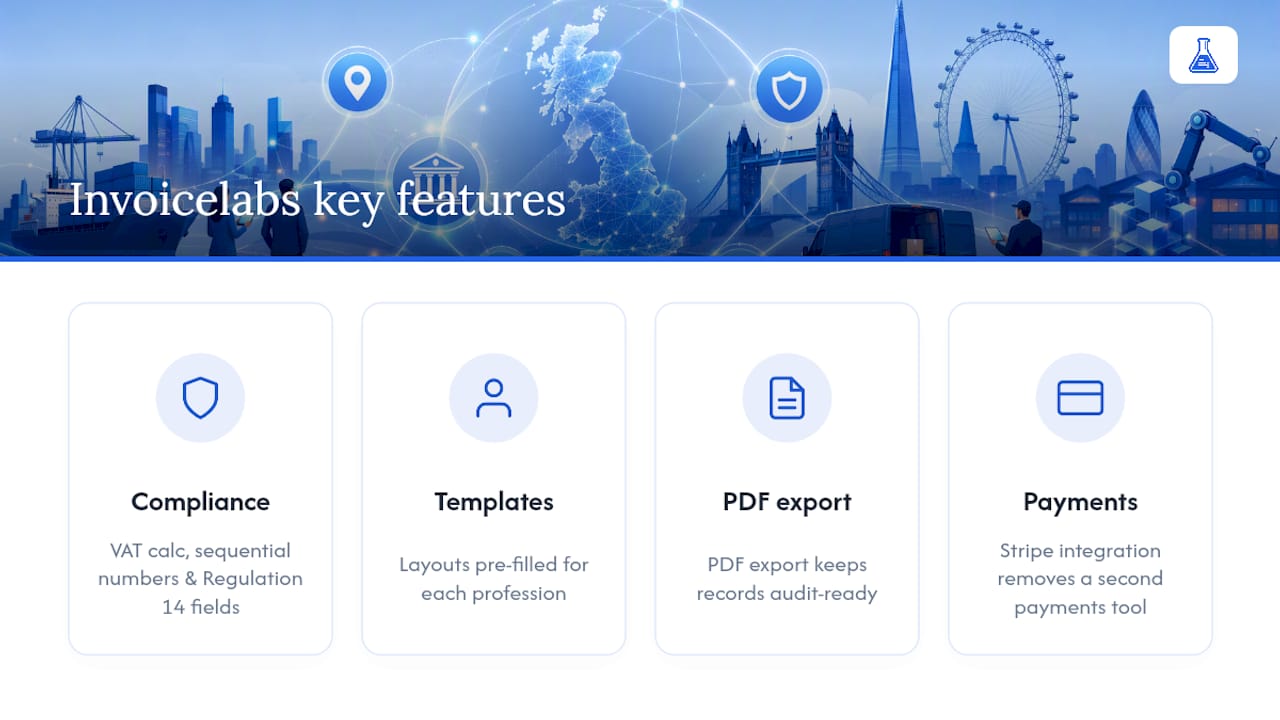
Invoicelabs is built for exactly the compliance headaches this article just walked through. Every invoice carries VAT calculation, sequential numbering, and the mandatory fields Regulation 14 requires, so you’re not manually rebuilding a checklist for every client.
Templates are matched to specific professions, so a consultant invoicing a reverse-charge client or a graphic designer billing a UK studio starts from a layout that already has the right fields in the right places. PDF export keeps records audit-ready, and Stripe integration means once the invoice is correct, getting paid doesn’t require a second tool. Fewer reissues, cleaner input tax trails for your clients, less time spent second-guessing a template you built two years ago.
Try the free invoice generator on your next VAT invoice and see how much of this checklist it handles automatically.
This article is general information, not a substitute for advice from a qualified financial advisor. Consult a qualified financial professional about your own circumstances before acting on anything here.
Recommended
Send your next invoice in seconds
Create professional invoices, track payments and get paid faster — free to start.