Templates and Recordkeeping: Partial Payment Invoice for Freelancers
A partial payment invoice records a payment that reduces what a client owes without changing the invoice’s original due date or terms. The invoice status shifts to “partially paid,” and the amount remaining equals the original total minus whatever has come in so far. If you want different terms, put that in writing rather than assuming the change is understood.
TL;DR:
- Deposits typically range from 25% to 50%, with common amounts for creatives at 30% and event bookings at 50 percent.
- Request deposits before starting work to cover costs, reserve dates, and reduce project abandonment risks, especially for large or long-term jobs.
- Log and reconcile partial payments carefully, ensuring the invoice status updates correctly and clear arithmetic is visible to avoid disputes.
- Include specific, clear terms on deposit non-refundable clauses, due dates for remaining balances, and payment methods to prevent misunderstandings.
- Use invoicing platforms that automate partial payment recording, update statuses instantly, and streamline sending deposit requests to prevent back-and-forth communication.
Table of Contents
- What Counts as a Partial Payment on an Invoice
- When Should You Request a Partial Payment?
- How Do You Create and Record a Partial Payment?
- What Terms Should You Put on a Deposit Invoice?
- How Do You Ask for a Deposit Without Sounding Pushy?
- How Should You Record Partial Payments for Accounting?
- What Mistakes Cause Partial Payment Disputes?
- Why Partial Payments Matter for Cash Flow
- Send Deposit Invoices Without the Back-and-Forth
- Sources
What Counts as a Partial Payment on an Invoice
Not every partial payment means the same thing, and mixing them up is how invoices get confusing fast. A deposit is money collected before work starts, usually to cover materials or reserve your time. A milestone payment ties to a specific stage of a project, like 40% on design approval. An installment splits a fixed total into scheduled chunks agreed in advance. A disputed partial payment is different again: a client pays the part of the invoice they don’t contest while a disagreement over the rest gets sorted out.
Deposit percentages vary by industry, but 25% to 50% is the common range, with many service businesses landing at 30% to 50%.
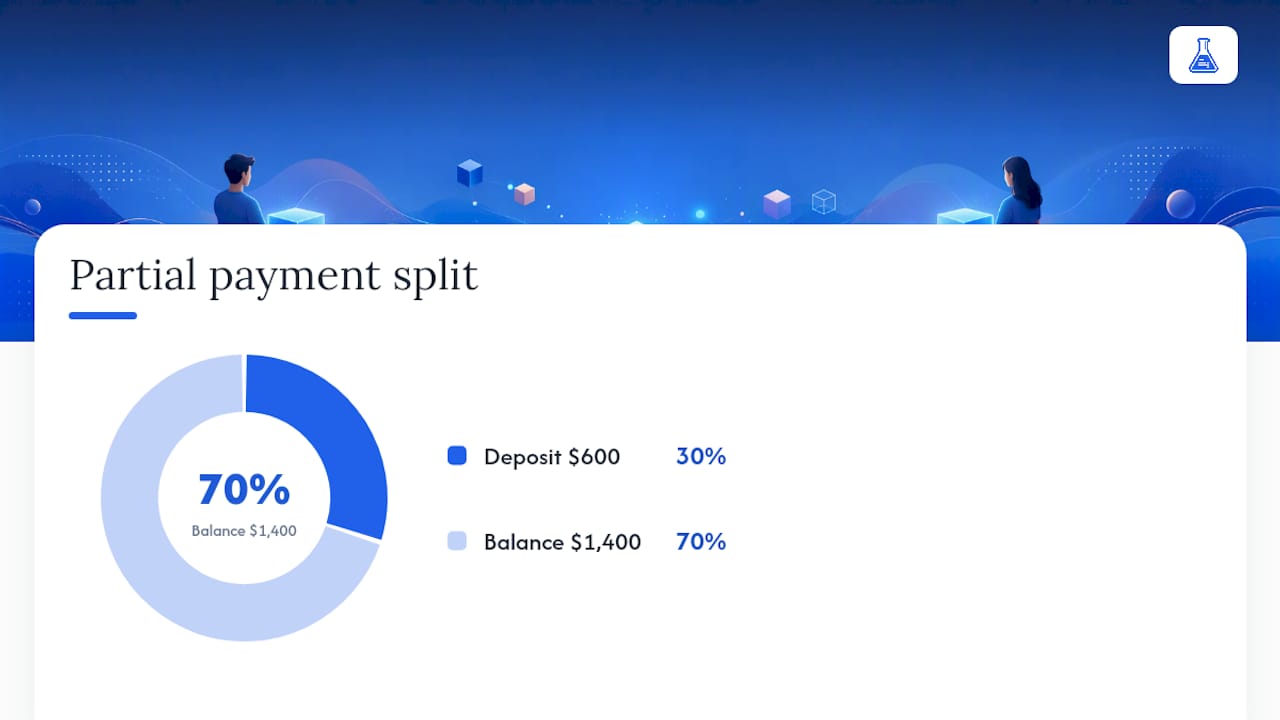
- Creative commission: A freelance illustrator asks for a 30% deposit before starting a $600 project, then $420 on delivery.
- Event booking: A photographer requires a 50% deposit to hold a wedding date, with the remainder due the week before the event.
When Should You Request a Partial Payment?
Ask for a deposit whenever you’re covering costs before you get paid: buying materials, blocking out a week of your calendar, or booking a supplier on a client’s behalf. It’s also worth requesting one from first-time clients or anyone whose payment history you don’t know yet. Large orders and long lead times are the other obvious triggers. If a job runs eight weeks, you shouldn’t be the one financing it interest free.
Frame the deposit as protection for both sides, not a hurdle. It reserves the date, locks in materials at today’s price, and confirms the client is serious. Faster upfront collection also tends to mean fewer stalled projects overall, since money on the table changes how seriously a client treats a deadline.
- Reserve materials or supplier bookings tied to the project
- Hold the client’s slot in your calendar
- Reduce the risk of walking away from unpaid work
Pro Tip: Tie your non-refundable clause to something concrete, like “non-refundable once materials are ordered on [date],” instead of a vague “deposits are non-refundable.” Specifics hold up better in a dispute.
How Do You Create and Record a Partial Payment?
Issuing a deposit invoice and logging what comes in against it follows a predictable sequence, whether you’re on a laptop or your phone.
To issue a deposit invoice:
- Show the full project total clearly at the top.
- List the deposit amount and the percentage it represents.
- Set a due date for the deposit itself, separate from the final balance.
- Assign the invoice a number you’ll reference later.
To record the payment once it lands:
- Log the amount received and the date.
- Note the payment method and any reference number from your bank or Stripe.
- Confirm the invoice status updates to “partially paid” and check the amount remaining is correct.
To apply later payments to the same invoice:
- Enter each new payment against the original invoice rather than creating a new one.
- Recalculate the balance after each entry.
Stripe’s own documentation confirms this is how partial payments behave on modern platforms: the status updates automatically, amount_remaining recalculates, and further payments apply to that same invoice. Worth knowing: some hosted payment pages restrict partial payments entirely, so check before you rely on that feature for a client-facing link.
Your final invoice should show the arithmetic plainly:
-
Project total: $2,000
-
Deposit credited (paid March 3): $600
-
Balance due (due March 20): $1,400
-
Desktop apps generally show more fields at once (deposit history, payment references)
-
Mobile apps often simplify the view, showing just total, paid, and remaining
-
Always double check the “partially paid” flag before sending a follow up, so you don’t chase money that already arrived
What Terms Should You Put on a Deposit Invoice?
An invoice that’s clear about money is one that never gets argued over later. At minimum, print the full total, the deposit amount and its percentage, the deposit invoice number, the date the deposit was paid, and the remaining balance with its own due date. Agiled’s deposit invoice template guidance recommends exactly this structure, and it’s hard to improve on.
- State refund terms in plain language: “Deposit is non-refundable once materials are ordered” beats “deposits are non-refundable.”
- Spell out how and when the balance will be invoiced, not just that it will be.
- Note accepted payment methods so there’s no back and forth at the finish line.
For late fees on the remaining balance, name a specific rate and a specific trigger, like “1.5% monthly interest applied after 30 days past due,” rather than a vague threat. Our guide on payment terms examples has more ready-to-copy language if you want a starting point.
Pro Tip: Print the deposit invoice number on the final invoice too. It takes five seconds and eliminates almost all “wait, when did I pay that?” emails.
How Do You Ask for a Deposit Without Sounding Pushy?
You don’t need a long email to request money professionally, and a short one usually lands better anyway.
- Deposit request: “To get started on [project], I ask for a 30% deposit ($X) by [date]. I’ll send an invoice with a payment link now, and work begins once it clears.”
- Deposit confirmation: “Got your deposit, thanks. This secures your slot for [date/materials]. I’ll invoice the remaining balance ($X) on [date].”
- Balance reminder: “Quick reminder: the balance of $X (total $Y minus your $Z deposit paid on [date]) is due [date]. Let me know if you need the invoice resent.”
Sending the deposit invoice the moment an agreement is reached, then confirming receipt right away, is standard advice from Stripe’s own resources on deposit invoicing, and it holds up in practice.
How Should You Record Partial Payments for Accounting?
Under accrual accounting, a deposit is unearned revenue. It’s a liability on your books, not income, until you’ve actually delivered the work or the goods.
- Credit the deposit against the total on your final invoice, with the payment date shown.
- Reconcile bank deposits against invoice numbers regularly, not just at tax time.
- For VAT purposes, show the full taxable supply on your final invoice and credit the deposit correctly rather than treating it as a separate, untaxed transaction.
Getting this wrong is one of the more common sources of revenue-recognition errors for small businesses, and it’s worth asking an accountant to check your setup once rather than guessing every quarter.
What Mistakes Cause Partial Payment Disputes?
Most disputes trace back to something small that got skipped, not bad faith.
- Not showing the deposit credited on the final invoice, so the client questions the balance
- Vague cancellation language that doesn’t name a trigger or a date
- Forgetting to log the payment method and reference number, which makes reconciliation a nightmare later
The fix is almost always the same: show your arithmetic, attach the original deposit invoice for reference, and confirm every payment by email with a reference number. If a balance stalls anyway, a polite reminder followed by a firmer written notice usually resolves it. When it doesn’t, our escalation guide for unpaid invoices walks through the next steps.
Why Partial Payments Matter for Cash Flow
Deposits solve a problem that’s easy to underestimate until you’ve financed a project out of your own pocket: the gap between spending money on materials and actually getting paid. A deposit closes that gap immediately, and it filters out clients who were never going to follow through. Some invoicing platforms address this friction with instant delivery, Stripe payment collection, and branded templates that streamline sending a deposit invoice.
— Black Flame Digital
Send Deposit Invoices Without the Back-and-Forth
Some invoicing platforms simplify a five-step deposit request into one screen: total, deposit percentage, due date, and a payment link, all sent quickly. That matters most for the exact situation this article covers. Chasing a balance manually across email threads and spreadsheets is where deposits usually fall apart.
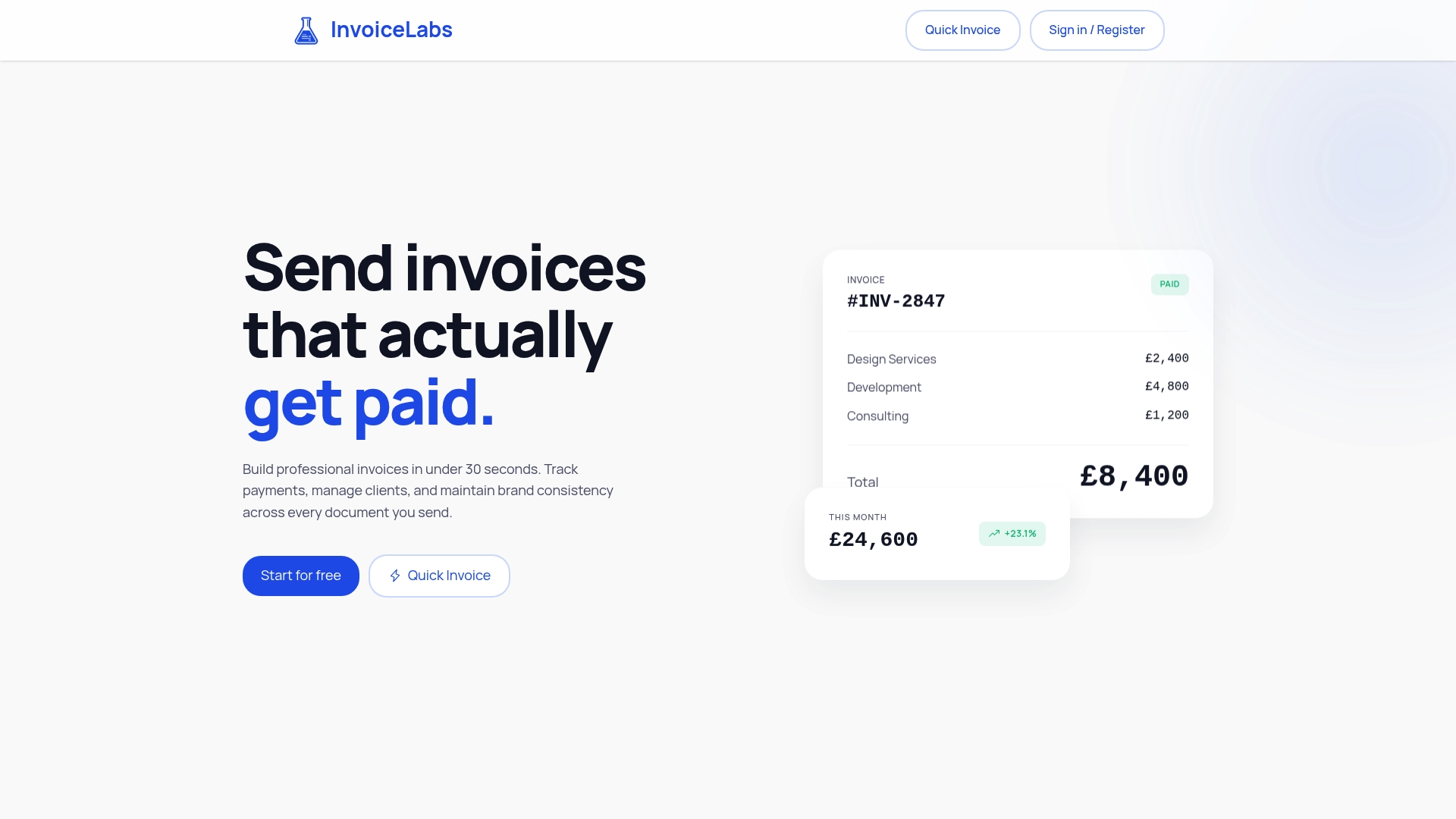
Invoices can keep your branding consistent, calculate tax automatically, and update to “partially paid” when a payment is made through Stripe, so you’re never guessing what’s outstanding. Transparent subscription terms avoid hidden fees. If you’re ready to send your next deposit invoice, create one free with the quick invoice tool and have it in a client’s inbox before your coffee goes cold.
Sources
For platform-level detail on how partial payments behave, Stripe’s documentation on accepting partial payments is the most direct reference. For template structure, Statrys covers when to use a deposit invoice and Agiled offers a ready-made deposit invoice template. If you bill nursery or childcare fees in stages, The Sunflower Nursery has a useful breakdown of staged payment workflows. For downloadable formats by profession, browse Invoicelabs’s template library.
- How partial payments work and when they’re used | Stripe
- What is a deposit invoice? Best time to use it & free templates | Statrys
- Deposit invoice template — Agiled
- Accept partial payments for invoices — Stripe documentation
Recommended
Send your next invoice in seconds
Create professional invoices, track payments and get paid faster — free to start.