PDF vs e-invoice: what UK freelancers and small businesses need to know
PDF vs e-invoice: what UK freelancers and small businesses need to know

A PDF invoice is a digital picture of a document that a person reads. An e-invoice is structured data that one accounting system sends straight into another. In the UK today a PDF is a perfectly valid invoice, and e-invoicing is voluntary for most businesses. From 1 April 2029 VAT-registered businesses will have to issue and receive VAT invoices as e-invoices unless an exemption applies. So the practical question for you is how to invoice quickly, look professional and get paid now, on a routine that will carry over when the rules change. That is what we built InvoiceLabs for: branded invoices in under 30 seconds, delivered instantly, with status tracking and card payment through Stripe.
TL;DR
- A PDF is an unstructured file made for human eyes. A true e-invoice is structured data that software reads without re-typing.
- HMRC accepts PDF invoices today, including by email, as long as the usual VAT invoice conditions are met.
- From 1 April 2029, VAT-registered businesses must issue and receive VAT invoices as e-invoices; the detailed requirements are due between October 2027 and April 2028.
- Getting paid faster today depends on how quickly you create, send and chase invoices, and how easily the client can pay.
- InvoiceLabs has a free plan at £0 per month, and paid plans start at £9 per month.
Table of Contents
- What a PDF invoice is, and what an e-invoice is
- Side by side: PDF invoice and structured e-invoice
- Does an invoice have to be a PDF in the UK?
- What changes in 2029, and what does not
- Why e-invoicing is attracting government attention
- Where late payment really comes from
- Choosing how to invoice: the options compared
- Which one suits which reader
- A routine that works in any format
- Start with InvoiceLabs
- Our perspective
- FAQ
- Sources
What a PDF invoice is, and what an e-invoice is
The two terms get mixed up because both are “electronic”. They are not the same thing.
A PDF invoice is a file. It shows the supplier name, the line items, the VAT and the total, laid out so a person can read them. A computer sees a page of shapes and text. Whoever receives it usually types the figures into their own accounting software by hand.
An e-invoice, in the sense the UK government now uses, is different. The government’s e-invoicing roadmap defines it as invoice data exchanged digitally and directly between the buyer’s and supplier’s financial systems, even where those systems differ, so it can flow into the buyer’s records automatically. The 2025 consultation response is explicit that PDFs, Word documents, JPEG images, HTML invoices, scanned images and faxes fall outside this narrower definition, because they do not carry structured data for automated processing.

The everyday version: if you email a PDF, you have sent an electronic invoice in the ordinary sense. If your software hands the invoice’s data to your customer’s software, you have sent an e-invoice in the government’s sense.
Side by side: PDF invoice and structured e-invoice
| PDF invoice | Structured e-invoice | |
|---|---|---|
| What it is | A document image or file, read by a person | Invoice data in a set digital format, read by software |
| Who handles it on receipt | Someone types or uploads the figures | The buyer’s system takes the data in automatically |
| Accepted by HMRC today | Yes | Yes |
| Required in the UK | No | Not yet; planned for VAT-registered businesses from 1 April 2029 |
| Branding | Full control over logo, colours and layout | Data-led, so the look matters less to the system |
| Typical use today | Freelancers, consultants, agencies, small businesses | Public procurement and larger buyers with integrated systems |
The branding row matters for the people reading this. When your client is a person approving a payment, the invoice is also a piece of your brand. A clear, consistent document with your logo, your payment details and an obvious total is part of how you look to the people who pay you.
Does an invoice have to be a PDF in the UK?
No. HMRC’s VAT Notice 700/63 says invoices can be on paper or electronic. It lists electronic formats including XML, EDI standards and PDF, provided the required data and control conditions are met. It describes an electronic invoice as either structured, such as XML, or unstructured, such as PDF. So a PDF is an accepted electronic invoice format under the current rules.
Sending is straightforward too. HMRC’s VAT records guidance says email satisfies the duty to issue an invoice, and the recipient may keep it electronically or print it, subject to the normal input tax rules.
What the invoice must contain is a separate matter. If you are VAT-registered, a missing field can cause trouble for you and for your customer when they reclaim VAT. Our guide to the mandatory fields on a UK VAT invoice lists all twelve.
What changes in 2029, and what does not
The government has set the direction. According to the roadmap published on 28 October 2026, from 1 April 2029 VAT-registered persons will need to issue and receive VAT invoices as e-invoices unless a specific exemption applies. The detailed requirements are to be confirmed between October 2027 and April 2028.
A few points help you plan without over-reacting:
- It is voluntary for now. ICAEW reported in October 2026 that e-invoicing remains optional for most UK businesses, although some public-sector buying already requires it.
- No central validation platform. ICAS reported that the 2029 regime is intended to be decentralised, with support and low-cost options for smaller businesses to be developed through the roadmap.
- No real-time reporting to HMRC in 2029. The same ICAS report says that is not part of the 2029 start, though the government will keep looking at possible later benefits.
The detail is still being written, so the sensible stance in the meantime is to keep your invoicing clean, consistent and digital. Tidy customer records, correct VAT treatment and a repeatable invoice routine are what any future format will need from you.
Why e-invoicing is attracting government attention
The case for structured invoices is about processing, not appearance. The roadmap notes that traditional formats can involve manual handling and re-keying, while structured exchange supports automation, better data quality and fewer errors. The consultation response adds that automated validation, matching and routing can reduce manual entry and human error, and that digital approval workflows can speed payment and improve cash flow.
On cost, the consultation response records respondents reporting invoice-processing costs from negligible amounts to more than £50 per invoice, with some at £30 to £50, and it states plainly that this spread is not a representative economy-wide average. The Small Business Commissioner repeats the consultation estimate that moving to e-invoicing can cut invoicing costs by 60% to 80%.
There is practical evidence from the NHS. A GS1 UK case study on PEPPOL-enabled processing reports automatic matching of invoices to purchase orders at 99.9% accuracy in one implementation, and a supplier query rate below 1% over three months.
These gains arrive when both sides use compatible systems. For a freelancer billing a handful of clients, most of the speed you can control sits earlier in the chain: how fast the invoice goes out, how clear it is and how simple it is to pay.

Where late payment really comes from
When payment is slow, the cause is rarely the file format. It is usually one of these:
- The invoice went out late. Invoicing at the end of the week or month, after the work is done, adds days before the clock even starts.
- It was hard to approve. A missing purchase order number, a wrong company name or an unclear total sends the invoice back to you. Our piece on the invoice approval workflow covers how to avoid it.
- Paying took effort. A bank transfer with details to copy is slower than a card payment link on the invoice itself.
- Nobody knew whether it had been seen. Without a status, you chase blindly.
Each of these is a process problem you can fix today, whatever format the invoice takes.
Choosing how to invoice: the options compared
For a UK freelancer, consultant, agency or small business, there are really four ways to produce invoices.
A branded online invoice from InvoiceLabs
This is the route we recommend, and it is why we built the product. You create a professional invoice in under 30 seconds, with tax and discounts calculated in real time, and it is delivered instantly. You can see its status, so you know when to follow up. You control the branding fully, with your logo and colours, and you can download a PDF whenever you need one. Professions get templates tailored to them, multi-currency is supported, and clients can pay by card through Stripe. The security is bank-grade, and we publish no hidden fees.
The pricing is simple:
| Plan | Price |
|---|---|
| Free | £0 per month |
| Starter | £9 per month |
| Professional | £19 per month |
| Business | £49 per month |
Card payments on invoices carry a 1% fee. Paid plans unlock additional clients and companies and unlimited invoices. If you only need a single invoice, the free invoice generator works without an account.
A Word or Excel template saved as PDF
Many people start here. It costs nothing, but every invoice is built by hand: you copy the previous one, change the number and the amounts, recalculate VAT, export, attach and send. Numbering mistakes and arithmetic slips creep in, there is no status, and the client has to pay by bank transfer. It suits someone sending a few invoices a year. Once you invoice monthly, the time adds up.
General invoice generators and other apps
Plenty of invoice generators and invoicing apps exist, including names such as invoice-generator.com, Moon Invoice and Genio. They vary in what they include on free tiers, in branding limits and in how they handle payments, so compare them on the questions that matter to you: how long an invoice takes, whether tax is calculated for you, whether you can see a status and how clients pay. We built InvoiceLabs around exactly those four.
Structured e-invoicing through accounting software or the Peppol network
Peppol is an international network for exchanging structured e-invoices. It is already used in public-sector supply chains, as the NHS example above shows. Large buyers with integrated finance systems are the ones asking for it first. If one of your customers requires this, you will be told and given the format; the full UK requirements for everyone else are not yet confirmed.
Which one suits which reader
- Freelancers who want invoices out fast: a branded online invoice with a free plan to start. Pick the quick invoice generator for one-offs and an account once you have regular clients. Our list of invoice templates for UK freelancers shows what a good layout includes.
- Agencies chasing payment: tracking and card payment links matter most. Our guide to agency invoicing shows a five-minute routine that fits the Professional or Business plan when you bill many clients and companies.
- Consultants protecting their brand: the invoice is often the last document a client sees from you. Full control over logo, colours and layout keeps it consistent with your proposals.
- Small business owners watching cost: the free plan costs £0 per month, and the Starter plan is £9 per month. Compare that with the time you spend assembling invoices by hand.
A routine that works in any format
Whether you send a PDF now or structured data later, the habits below make every invoice easier to pay:
- Invoice on the day the work is agreed as done, not at month end.
- Use a unique, sequential invoice number and keep it in order.
- Show the VAT line clearly if you are registered, using the fields in our VAT invoice guide.
- Put the payment terms and the due date on the invoice itself.
- Offer a way to pay immediately, such as a card link.
- Check the status and follow up on the due date, not a fortnight later.
- Keep your customer details accurate, including the company name and any reference the client needs.
If you handle personal data of clients, remember that invoices contain it. Our GDPR and invoicing guide covers storage and sharing.
Start with InvoiceLabs
If you want invoices that look like your business, arrive instantly and show their status, our plans start free. Create your first invoice in under 30 seconds, and add Stripe card payments when you are ready to collect faster. See the InvoiceLabs plans and pick the one that matches how many clients you bill.
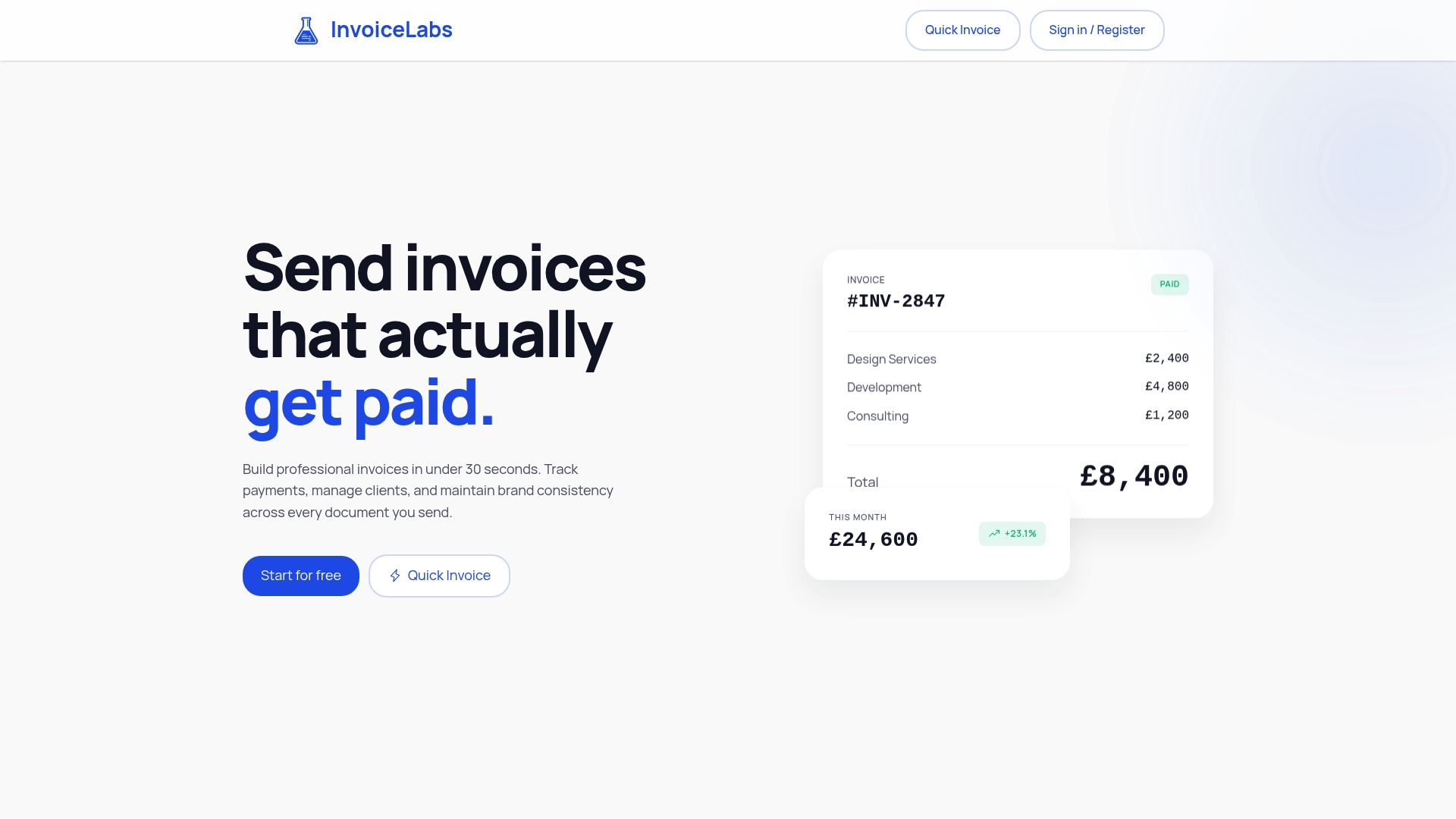
For a single invoice with no account, use the free invoice generator.
Our perspective
Most debates about PDF against e-invoice focus on file formats. In our experience of what freelancers and small teams need, the format is not what slows down payment. Time to send, clarity and ease of paying are.
That is why we designed InvoiceLabs around speed: an invoice in under 30 seconds, tax worked out as you type, delivery that is instant and a status you can see. A client who receives a clear, branded invoice with a card payment option has fewer reasons to wait.
Rules will change in 2029, and the detail is still being written. What will not change is that the people who invoice promptly and keep tidy records are best placed for whatever comes. We would rather you build that habit now, on a free plan if that is all you need, than wait for a deadline.
Black Flame Digital
FAQ
What is an e-invoice?
In the UK government’s definition, an e-invoice is invoice data exchanged digitally and directly between a supplier’s and a buyer’s financial systems, so the buyer’s software can take it in automatically. A PDF or a scanned image does not count under that narrower definition, even though it is sent electronically.
Does an invoice have to be a PDF?
No. HMRC allows paper and electronic invoices, and electronic formats can include PDF, XML and EDI standards when the required conditions are met. A PDF sent by email is accepted today. Choose the format your customer can process easily.
Is a PDF invoice an e-invoice?
In everyday speech, often yes, because it is an invoice sent electronically. Under the government’s 2029 plans, a PDF will not meet the structured-data definition. Until the rules apply to you, a PDF remains a valid way to invoice.
When does e-invoicing become mandatory in the UK?
From 1 April 2029, VAT-registered businesses will need to issue and receive VAT invoices as e-invoices unless an exemption applies. The government says the detailed requirements will be confirmed between October 2027 and April 2028, so check GOV.UK for the latest guidance.
How do I make my invoice a PDF?
If you create it in InvoiceLabs, you can download the invoice as a PDF from the finished document. With a Word or Excel template, use the save or export option and choose PDF before sending.
Sources
- Roadmap for e-invoicing implementation, GOV.UK
- Promoting electronic invoicing across UK businesses and the public sector: consultation response, GOV.UK
- Electronic invoicing (VAT Notice 700/63), GOV.UK
- VATREC6080: transmission of invoices, HMRC manual
- E-invoicing for small businesses, Small Business Commissioner
- Economy explainers: e-invoicing, ICAEW
- Autumn Budget 2025: e-invoicing will go ahead from 2029, ICAS
- Helping NHS organisations better manage non-pay spend, GS1 UK case study
Recommended
Send your next invoice in seconds
Create professional invoices, track payments and get paid faster — free to start.


