Top Invoicing Software for Small Businesses in 2026
What is the best invoicing software for small businesses and freelancers?
The short answer: QuickBooks Online leads for accounting integration, Zoho Invoice wins on free-plan value, and FreshBooks is the go-to for freelancers who bill by the hour. But the right pick depends entirely on how you work, what you charge, and how fast you need to get paid.
The 35 platforms below cover every major use case, from solo freelancers sending five invoices a month to agencies managing hundreds of clients across multiple currencies. The comparison table covers pricing, key features, ease of use, integrations, and scalability so you can find your match without reading every entry.
| Software | Best For | Pricing | Key Features | Ease of Use | Integrations | Scalability |
|---|---|---|---|---|---|---|
| QuickBooks | SMBs needing accounting integration | Paid plans | Invoice-to-ledger mapping, automation APIs | Moderate | Extensive | High |
| FreshBooks | Freelancers, time-based billing | Paid (30-day trial) | Time tracking, client portals | Very easy | Good | Moderate |
| Zoho Invoice | Free plan users, growing firms | Free / paid tiers | Up to 1,000 invoices/year free, reminders | Easy | Strong (Zoho suite) | High |
| Wave | Micro businesses, sole proprietors | Free core | Accounting, payments, ad-free | Very easy | Limited | Low |
| Xero | SMBs wanting accounting + invoicing | Paid plans | Bank feed sync, invoice automation | Moderate | Extensive | High |
| Invoice2go | Mobile-first professionals | Paid plans | Offline mode, fast mobile creation | Very easy | Limited | Low |
| Square Invoices | Retail, POS-integrated businesses | Free / paid | Unlimited invoices, POS hardware sync | Easy | Square ecosystem | Moderate |
| PayPal Invoicing | Simple invoice-to-payment cycles | Free (transaction fees) | No PayPal account for payers, tracking | Very easy | PayPal only | Low |
| Harvest | Freelancers, project billing | Free (1 seat) / paid | Time tracking, QuickBooks/Xero sync | Easy | Strong | Moderate |
| Bill.com | SMBs automating AP/AR | Paid plans | Approval workflows, electronic payments | Moderate | Strong | High |
| Invoicera | Complex billing workflows | Paid plans | Custom workflows, automation | Moderate | Good | High |
| Stripe Invoicing | International, multi-currency | Pay-per-use | 135+ currencies, subscriptions | Moderate | Extensive (APIs) | Very high |
| monday CRM | CRM + invoicing combined | Paid plans | Pipeline + invoice tracking | Easy | Strong | High |
| Invoice Ninja | Open-source, custom workflows | Free / paid | Custom templates, third-party integrations | Moderate | Strong | High |
| Bookipi | Solo freelancers, mobile use | Free / paid | Fast generation, expense tracking | Very easy | Limited | Low |
| Paymo | Teams managing projects + billing | Free / paid | Time tracking tied to invoices | Easy | Moderate | Moderate |
| Invoiced | AR automation, collections | Paid plans | Auto reminders, payment reconciliation | Moderate | Strong | High |
| myBillBook | Small businesses, GST billing | Free / paid | GST-compliant invoices, mobile | Easy | Limited | Low |
| Hiveage | Subscription billing, freelancers | Free / paid | Recurring invoices, client portal | Easy | Moderate | Moderate |
| Zervant | Free, simple invoicing | Free / paid | Core invoicing, free forever | Very easy | Limited | Low |
| ZipBooks | Accounting + invoicing, free tier | Free / paid | Payments, accounting features | Easy | Moderate | Moderate |
| Invoicely | Affordable cloud invoicing | Paid tiers | Multi-user support, tiered pricing | Easy | Limited | Low |
| SimplyBill | SaaS, subscription billing | Paid plans | Usage-based metering, subscriptions | Moderate | Moderate | Moderate |
| BigTime | Consulting, professional services | Paid plans | Project cost tracking, invoice automation | Moderate | Strong | High |
| Scoro | All-in-one workflow + billing | Paid plans | Task management, billing, reporting | Moderate | Strong | High |
| WORK[etc.] | SMBs: CRM + project + invoicing | Paid plans | Unified customer and billing workflows | Moderate | Moderate | Moderate |
| HoneyBook | Creative freelancers, agencies | Paid plans | Client workflows, payments | Easy | Moderate | Moderate |
| ChargeBee | SaaS, complex subscriptions | Paid plans | Proration, metered billing, multi-currency | Moderate | Extensive | Very high |
| OneUp | All-in-one: accounting, CRM, inventory | Paid plans | Inventory + invoicing + accounting | Moderate | Moderate | Moderate |
| KashFlow | Small businesses, simple accounting | Paid plans | Cloud interface, compliance | Easy | Moderate | Moderate |
| TimeTracker by eBillity | Time-based billing, agencies | Paid plans | Accurate time capture, invoice linkage | Easy | Moderate | Moderate |
| Sage Business Cloud Accounting | Scalable cloud accounting | Paid plans | Payroll, inventory, invoicing | Moderate | Strong | High |
| BillQuick Online (BQE) | Professional firms, detailed billing | Paid plans | Advanced reporting, project tracking | Moderate | Strong | High |
| Bench | Outsourced bookkeeping + invoicing | Paid plans | Human bookkeeping + simple invoicing | Easy | Limited | Low |
| Helcim | Payment + invoicing, no monthly fee | Pay-as-you-go | No monthly fees, unlimited invoices | Easy | Moderate | Moderate |
Standout attributes at a glance:
- QuickBooks Online is ranked best overall for accounting integration and invoice-to-ledger mapping consistency.
- Zoho Invoice offers up to 1,000 invoices per year on its free plan, with automatic reminders and a client portal included.
- Square Invoices provides unlimited invoices with POS hardware integration at no extra cost.
- Stripe Invoicing supports over 135 currencies, making it the strongest choice for businesses with international clients.
- FreshBooks pairs a clean interface with built-in billable hour tracking, which is why freelancers consistently rank it highly.
- Harvest integrates directly with QuickBooks, Xero, Asana, and Basecamp, covering both billing and project management in one workflow.
- Bill.com automates the full approval-to-payment cycle, reducing manual touchpoints for accounts payable and receivable teams.
- ChargeBee and Stripe Invoicing both handle complex subscription billing, but ChargeBee offers more granular proration and metered billing controls.
- Helcim charges no monthly fee, making it a genuine option for businesses with variable invoice volumes.
- HoneyBook bundles contracts, invoices, and payments into a single client workflow, which creative professionals find particularly useful.
Why invoicing software matters more than most small businesses realize
Getting paid on time is the single biggest cash flow lever a small business controls. Yet many owners still rely on spreadsheets or Word templates, which creates avoidable delays, errors, and gaps in their financial records.

Good invoicing software automates the invoice-to-payment lifecycle, including proposal conversions, automated payment reminders, and reconciliation. That automation directly reduces late payments and keeps cash moving. A missed reminder on a $3,000 invoice sitting unpaid for 30 extra days is a real cost, not a hypothetical one.
Beyond cash flow, invoicing software creates audit-ready records. Every sent invoice, payment received, and outstanding balance is logged automatically. When tax season arrives or a client disputes a charge, you have a clean paper trail without digging through email threads.
The businesses that benefit most fall into a few clear categories:
- Freelancers and consultants billing by the hour or project, who need time tracking tied directly to invoices.
- Agencies and small teams managing multiple clients simultaneously, where manual tracking breaks down fast.
- Retail and service businesses that need invoicing connected to their point-of-sale system.
- SaaS and subscription businesses requiring recurring billing, proration, and usage-based metering.
- International sellers who invoice in multiple currencies and need compliant tax handling across markets.
Compliance is another underrated benefit. Platforms like QuickBooks and Xero maintain tax tables, apply the correct rates automatically, and generate reports that align with IRS record-keeping requirements. That alone saves hours at year-end.
Key features to look for in invoicing software
The difference between a frustrating tool and one you actually use every day usually comes down to a handful of specific capabilities. Not every feature matters equally for every business type, but these are the ones worth evaluating before you commit.
Recurring invoices and automated reminders. If you bill the same clients monthly, you should never have to create that invoice manually. Platforms like Hiveage, ChargeBee, and SimplyBill handle recurring billing natively. Automated payment reminders, available in Zoho Invoice’s free plan and most paid tiers across the board, cut down on the awkward “just following up” emails.
Payment integrations. The faster a client can pay from the invoice itself, the faster you get paid. Look for platforms that accept credit cards, ACH transfers, and digital wallets. Stripe Invoicing supports over 135 currencies and regional methods like SEPA and Pix. Square Invoices connects directly to Square’s payment hardware. PayPal Invoicing lets clients pay without a PayPal account, which removes a common friction point.
Accounting integration. Deep integration with accounting and CRM systems reduces manual data entry and keeps your books accurate. QuickBooks and Xero both offer invoice-to-ledger mapping, meaning every invoice automatically posts to the correct account. Harvest syncs with both, so project billing flows straight into your accounting software.

Mobile app functionality. Invoice2go and Bookipi are built mobile-first, with offline mode and fast invoice creation on a phone. Most major platforms, including FreshBooks, Wave, and Zoho Invoice, offer capable mobile apps, but the depth varies. If you invoice on job sites or while traveling, test the mobile experience specifically.
Security and compliance. Bank-grade encryption, two-factor authentication, and role-based access controls matter more as your client list grows. Platforms handling payment data should be PCI-compliant. For US businesses, look for software that maintains current federal and state tax tables.
Customization and branding. Your invoice is often the last touchpoint before a client pays. Logo placement, custom colors, and branded templates keep your business looking professional. Most paid tiers across FreshBooks, Invoicera, and Invoice Ninja offer full template customization.
Scalability. Free tiers often impose hidden limits on client counts, user seats, or automation features, leading to forced upgrades at the worst time. Check the ceiling on each plan before you start building your client list on it.
Client portals. A dedicated portal where clients can view invoices, approve estimates, and make payments reduces back-and-forth email significantly. FreshBooks, Zoho Invoice, and Hiveage all include client portals, even at lower plan tiers.
Detailed overviews of the top invoicing platforms
The 35 platforms in this comparison cover a wide range of use cases. Rather than treating every option identically, the profiles below give more depth to the platforms with the most distinct positioning, and shorter entries to those with narrower differentiation.
QuickBooks Online
QuickBooks Online is the best overall choice for small businesses that need accounting and invoicing in one place. Recurring invoices generate transactions with configured item, tax, and revenue mappings automatically, which keeps the ledger clean without manual posting. Its API surface is extensive enough for teams that want to automate provisioning or integrate with ERP workflows. The tradeoff is cost: QuickBooks is one of the pricier options in this list, and the interface has a learning curve for users who just want to send a quick invoice.
FreshBooks
FreshBooks is purpose-built for freelancers and small teams who bill by the hour. The interface is genuinely easy to navigate, and the billable hour tracking ties directly into invoice generation, so you’re not manually transferring time logs. Its 30-day free trial requires no credit card, which is a low-risk way to test whether it fits your workflow. For a freelancer-focused billing guide, the combination of time tracking and client portals makes FreshBooks a natural starting point.
Zoho Invoice
Zoho Invoice’s free plan is genuinely generous. You get a substantial number of invoices per year, customizable templates, automatic reminders, and a client portal, all without ads and without paying anything. The catch is the one-user limit on the free tier. As your business grows, upgrading to Zoho Books unlocks multi-user access, inventory, and deeper accounting features, making the transition relatively smooth within the Zoho ecosystem.
Wave
Wave is the right call for sole proprietors and micro businesses that need core invoicing and basic accounting at no cost. The free plan includes integrated accounting and payment processing, and there are no ads. Payment processing fees apply when clients pay by card, which is standard. Wave’s scalability ceiling is low, so businesses expecting rapid growth will likely outgrow it within a year or two.
Xero
Xero’s bank feed integration is its clearest differentiator. Transactions import automatically, reconcile against invoices, and post to the correct accounts with minimal manual input. It’s a strong fit for small to medium businesses that want accounting and invoicing tightly connected. Xero also supports multi-currency invoicing and has an extensive app marketplace for adding payroll, inventory, and project management tools.
Stripe Invoicing
For businesses with international clients, Stripe Invoicing is hard to beat. It generates invoices in more than 25 languages and supports over 135 currencies, with regional payment methods including SEPA, Payto, and Pix. Subscription billing, trial period management, and plan upgrades are all handled natively. The pay-per-use pricing model means no monthly fee, but transaction costs add up at volume. Teams comfortable with APIs can build highly customized billing workflows on top of Stripe’s infrastructure.
Harvest
Harvest earns its place for freelancers and agencies that manage projects alongside billing. Time entries link directly to invoices, and the platform syncs with QuickBooks, Xero, Asana, and Basecamp. The free plan covers one seat and two projects, which is enough to evaluate the workflow. Paid plans unlock unlimited projects and team seats.
Bill.com
Bill.com targets SMBs that need to automate both accounts payable and accounts receivable. Invoice approvals, electronic payments, and reconciliation all run through a single workflow. It’s more infrastructure than invoicing app, which means the setup investment is higher, but the payoff for businesses processing high invoice volumes is real.
Invoice Ninja
Invoice Ninja is the open-source option for businesses that want full control over their invoicing setup. The self-hosted version is free, and the cloud version offers a generous free tier. Template customization is deep, and third-party integrations cover most major payment gateways and accounting platforms. If you have technical resources, Invoice Ninja can be configured to match almost any billing workflow.
HoneyBook
HoneyBook bundles contracts, invoices, and payment collection into a single client-facing workflow. Creative freelancers, photographers, and event professionals find it particularly useful because the entire client journey from proposal to final payment lives in one place. It’s not the cheapest option, but the workflow consolidation saves time that would otherwise go to managing separate tools.
BigTime and BQE (BillQuick Online)
Both BigTime and BillQuick Online (BQE) target professional services firms: consultants, engineers, architects, and legal teams. BigTime focuses on project cost tracking and invoice automation, while BQE adds advanced reporting and detailed expense tracking. Neither is a lightweight tool, but for firms that bill complex multi-phase projects, the depth is worth the setup time.
ChargeBee
ChargeBee is built specifically for SaaS and subscription businesses. Proration, metered billing, multi-currency support, and plan upgrade management are all native features. If your revenue model involves any complexity beyond a flat monthly fee, ChargeBee handles it more cleanly than general-purpose invoicing tools.
Helcim
Helcim charges no monthly subscription fee. You pay only when you process a payment, and unlimited invoices are included. For businesses with variable invoice volumes, that pricing model avoids the fixed cost of a monthly plan during slow periods. The invoicing features are straightforward rather than feature-rich, but for payment-integrated billing without overhead, Helcim is a practical choice.
The remaining platforms
Several platforms in this list serve narrower or more specific audiences:
- Invoice2go suits mobile-first professionals who need fast invoice creation on a phone, including offline mode.
- Square Invoices is the natural choice for retail businesses already using Square’s POS hardware.
- PayPal Invoicing works well for businesses whose clients already use PayPal and want the simplest possible payment path.
- Paymo and TimeTracker by eBillity both connect time tracking to invoicing, with Paymo adding project management features.
- Invoiced focuses on AR automation, including automated delivery, reminders, and payment reconciliation.
- Scoro and WORK[etc.] combine CRM, project management, and invoicing into all-in-one platforms for SMBs.
- Bookipi and Zervant offer free, simple invoicing for solo operators who need nothing more than the basics.
- Sage Business Cloud Accounting provides payroll and inventory options alongside invoicing for businesses that need a broader accounting platform.
- Bench pairs human bookkeeping with simple invoicing, suited to owners who prefer to outsource financial management entirely.
- myBillBook targets small businesses needing GST-compliant invoicing with mobile support.
- Hiveage, ZipBooks, Invoicely, SimplyBill, KashFlow, and OneUp each serve specific niches: subscription billing, free-tier accounting, affordable cloud invoicing, SaaS metering, UK-oriented compliance, and all-in-one financial management, respectively.
- monday CRM suits teams that want CRM pipeline management and invoicing in a single workspace.
Pro Tip: Before committing to any platform, check whether the free tier limits client count, user seats, or automation. Those caps are where free plans hit their ceiling faster than most businesses expect.
How to choose the best invoicing software for your business
The right invoicing software is the one that fits how you actually work, not the one with the longest feature list. Start with these questions before you evaluate any specific platform.
What is your invoice volume and frequency? A freelancer sending 10 invoices a month has very different needs than an agency processing 200. Zoho Invoice’s free plan covers a substantial number of invoices annually, which is plenty for most solo operators. High-volume businesses should look at platforms with unlimited invoicing, like Square Invoices or Helcim.
Do you need accounting integration or just invoicing? If you already use QuickBooks or Xero for accounting, pick an invoicing tool that syncs with it natively. If you need both in one place, QuickBooks Online or Xero themselves are the logical choice. Mixing a standalone invoicing app with a separate accounting platform works, but only if the integration is solid.
What is your budget, and what are the real costs? Monthly subscription fees are only part of the picture. Check transaction fees on card payments, setup costs, and what features are locked behind higher tiers. Helcim and PayPal Invoicing charge no monthly fee but take a cut of each transaction. Wave’s core plan is free, but payment processing costs apply.
How do your clients prefer to pay? If your clients are international, you need multi-currency support and regional payment methods. Stripe Invoicing covers 135+ currencies. If your clients are domestic and mostly pay by card or ACH, most platforms handle that without issue.
Will you outgrow it? Scalability, integration depth, and mobile access are the factors that matter most as a business grows. Transitioning from a free plan to a paid one can be cumbersome if the platform makes data export difficult. Choose a platform with a clear upgrade path and smooth migration, especially if you plan to add team members or expand your client base.
Red flags to watch for:
- Hidden fees for features that competitors include by default (PDF downloads, payment reminders, multi-user access).
- No free trial or money-back guarantee. Testing a real workflow before committing is the only reliable way to know if a tool fits.
- Limited customer support. If something breaks during a billing cycle, you need help fast. Check whether support is available by phone, chat, or email, and at what hours.
- Lock-in through proprietary data formats that make it hard to export your invoice history if you switch.
For a closer look at the most cost-effective alternatives to the market leaders, the cheapest invoicing software options break down where you can get the most value without overpaying.
Invoicelabs: built for professionals who need to invoice fast
Most invoicing platforms are built around accounting workflows. Invoicelabs takes a different approach: it’s built around speed and simplicity for the professional who needs to send a branded invoice right now, without navigating a full accounting suite.
Invoicelabs lets you generate a professional invoice in under 30 seconds, with real-time tax calculations applied automatically and instant delivery to the client. Payment tracking shows you exactly when an invoice has been viewed and when payment is made, so you’re not left guessing. Stripe integration handles card payments securely, and the platform carries bank-grade security with no hidden fees.
For freelancers and agencies, the branding features matter. You can apply your logo, brand colors, and custom templates to every invoice, which keeps your documents consistent across clients. Multi-currency support covers international billing without requiring a separate tool. The free plan lets you create invoices without even creating an account, which is useful for one-off projects or testing the workflow before committing.
Key capabilities include:
- Invoice creation in under 30 seconds with real-time tax and discount calculations.
- Instant delivery and live payment tracking via the client dashboard.
- Stripe-powered card payment collection with bank-grade security.
- Full brand customization: logo, colors, and profession-specific templates.
- Multi-currency support for international clients.
- Accountless quick invoice creation for one-off billing needs.
- Downloadable PDF invoices with no watermarks on paid plans.
Invoicelabs fits best for freelancers, consultants, and small agencies who want professional invoicing without the overhead of a full accounting platform. If you’re currently using a complex system that slows you down, or if you’re just starting out and want something that works immediately, it’s worth trying the free invoice generator before evaluating paid options.
Invoicelabs offers a faster path to getting paid
If the platforms compared above feel like more software than you actually need, Invoicelabs is worth a look. Those tools are built for businesses that need deep accounting integration, complex approval workflows, or enterprise-level reporting. Invoicelabs is built for the professional who needs to send a clean, branded invoice quickly and get paid without friction.
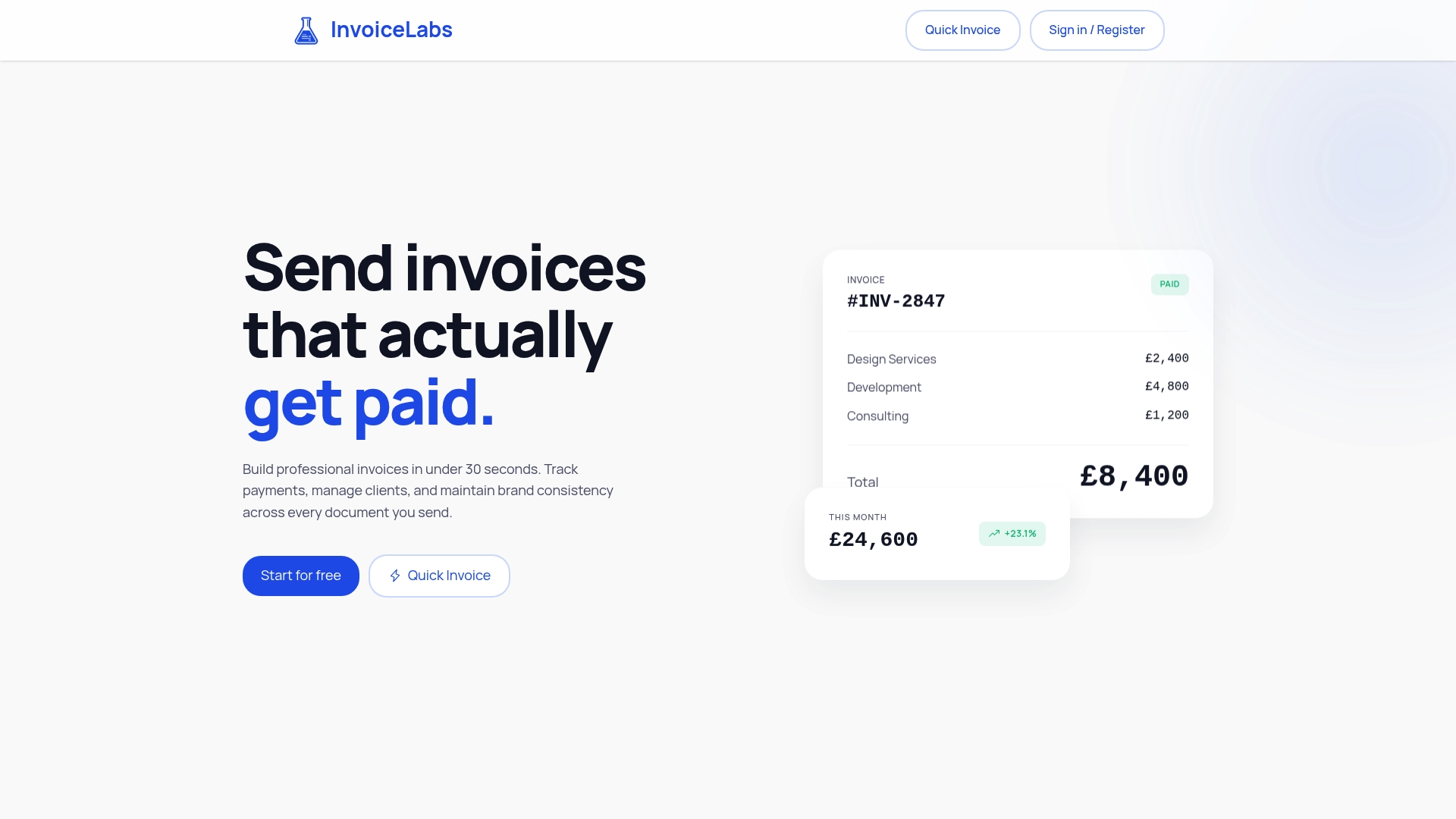
The core difference is focus. Where QuickBooks and Xero are full accounting platforms that include invoicing, Invoicelabs is an invoicing platform, full stop. No accounting modules to configure, no chart of accounts to set up, no learning curve before you can send your first invoice. You can create a professional invoice in under 30 seconds, track whether the client has opened it, and collect payment via Stripe, all without a monthly subscription on the free plan.
For freelancers, consultants, and small agencies who want professional invoicing without the overhead, the free invoice generator is the fastest way to see whether it fits your workflow. Profession-specific templates are also available for web developers, graphic designers, and consultants who want a branded starting point.
Key Takeaways
The best invoicing software matches your business model: freelancers need time tracking and simple interfaces, while growing SMBs need accounting integration and scalability.
| Point | Details |
|---|---|
| Free plans have real limits | Zoho Invoice’s free tier covers a generous number of invoices annually, but most free plans cap clients, users, or automation features. |
| Accounting integration drives accuracy | QuickBooks Online’s invoice-to-ledger mapping keeps books accurate without manual posting, making it the top pick for SMBs. |
| International billing needs Stripe | Stripe Invoicing supports over 135 currencies and regional payment methods, making it the strongest choice for global sellers. |
| Scalability should be evaluated upfront | Transitioning from a free to a paid plan can be difficult if the platform restricts data export; choose one with a clear upgrade path. |
| Invoicelabs suits speed-focused professionals | Invoicelabs generates branded invoices in under 30 seconds with Stripe payments and real-time tracking, with no accounting overhead. |
Recommended
Send your next invoice in seconds
Create professional invoices, track payments and get paid faster — free to start.