Credit Invoice Example: A Practical Guide for Small Businesses
A credit invoice is a formal document that reduces or adjusts the amount charged on a prior invoice. It does not delete the original record. Instead, it sits alongside it, creating a clear paper trail that shows what was charged, what was reversed, and why.
You might also hear it called a credit note or credit memo. The terms are used interchangeably in practice, though “credit memo” tends to appear more in B2B accounting contexts while “credit note” is common in service-based industries. Either way, the function is identical: formally reduce what a customer owes without touching the original invoice.
Table of Contents
- What is a credit invoice and what goes on it?
- When should you issue a credit invoice?
- What a compliant credit invoice must contain
- How to write a credit invoice, step by step
- Credit invoice examples and template formats
- Legal and accounting implications of credit invoices
- Best practices for sending and tracking credit invoices
- How to handle credit invoices in accounting software
- Key Takeaways
What is a credit invoice and what goes on it?
A credit invoice is a legally binding document that adjusts a previously issued invoice by reducing the amount owed. It does not erase the original charge. Both documents stay on file, and the credit invoice records the correction, lowering the customer’s balance or triggering a refund.
Every compliant credit invoice includes these elements:
- Unique credit invoice number (e.g., CN-2026-001, separate from your invoice sequence)
- Issue date
- Reference to the original invoice number and date
- Your business name and contact details
- Customer name and billing address
- Itemized list of credited products or services, mirroring the original invoice line by line
- Tax reversal per line item, at the same rate as the original
- Total credit amount
- Reason for the credit (e.g., “return of two units,” “pricing error corrected”)
The reference to the original invoice is what separates a proper credit invoice from a vague refund note. Without it, you have what accountants call an orphan credit: a floating adjustment that nobody can trace back to a specific charge.
When should you issue a credit invoice?
The short answer: any time an invoice you already sent turns out to be wrong, or the deal behind it changes after the fact. The temptation is to open the original and quietly edit the number. That is exactly what accountants warn against. Invoices must not be deleted once issued; a credit invoice is the correct way to adjust the record.
Common triggers include:
- Overbilling or pricing error: You charged $1,200 instead of $1,000. Issue a credit invoice for $200.
- Product return: A customer sends back defective goods. The credit invoice reduces their balance and updates your inventory records.
- Cancelled or partially delivered order: If a project was cancelled midway, a partial credit covers the undelivered portion while leaving the completed work payable.
- Discount applied after invoicing: A loyalty discount agreed after the invoice was sent gets documented through a credit invoice rather than a revised invoice.
- Duplicate invoice: You accidentally billed the same job twice. A full credit invoice cancels one of them entirely.
Full vs. partial credits: A full credit invoice cancels the entire original invoice, bringing its balance to zero. A partial credit reverses only specific lines, leaving the rest of the invoice payable. Most real-world corrections are partial, because usually one line was wrong while the rest was fine.
One more distinction worth knowing: a credit invoice reduces what a customer owes on paper, but no cash moves. A refund is the separate act of returning actual money. In B2B transactions with payment terms, you will often issue a credit invoice first and then decide whether to refund the cash or apply it to the next invoice.

What a compliant credit invoice must contain
Getting the format right protects you in a tax audit. Here is what each required element actually does:
- Unique sequential numbering: Never reuse invoice numbers for credit invoices. A separate sequence (CN-2026-001, CN-2026-002) keeps your audit trail clean and prevents gaps in your invoice register.
- Original invoice reference: Copy the original invoice number and date onto the credit invoice as a dedicated reference line. Tax authorities use this link to verify that the credit is legitimate and not a fabricated reduction.
- Exact line item mirroring: Credit the specific lines that changed, using the same descriptions and the same tax rate as the original. A rounded lump sum that does not match any line item creates reconciliation headaches for both sides.
- Tax reversal per line: If you charged sales tax on the original invoice, the credit invoice must show the same rate applied to the credited net amount. This reduces the tax you owe and adjusts what the customer can reclaim.
- Clear reason statement: A short phrase is enough. “Return of two units” or “correction of hours billed” prevents disputes six months later when nobody remembers the context.
- Total credit amount: Show the net credit and the tax credit separately, then the combined total at the foot of the document.
Missing any of these elements can cause problems during an audit. Tax authorities in the US and internationally increasingly scrutinize invoice sequencing, and an undocumented credit with no original invoice reference is a red flag.
Pro Tip: If you work with a tax advisor, share your credit invoice format with them before you need to use it. Services like tax planning specialists can confirm your format meets current IRS recordkeeping standards and flag any gaps before an audit does.
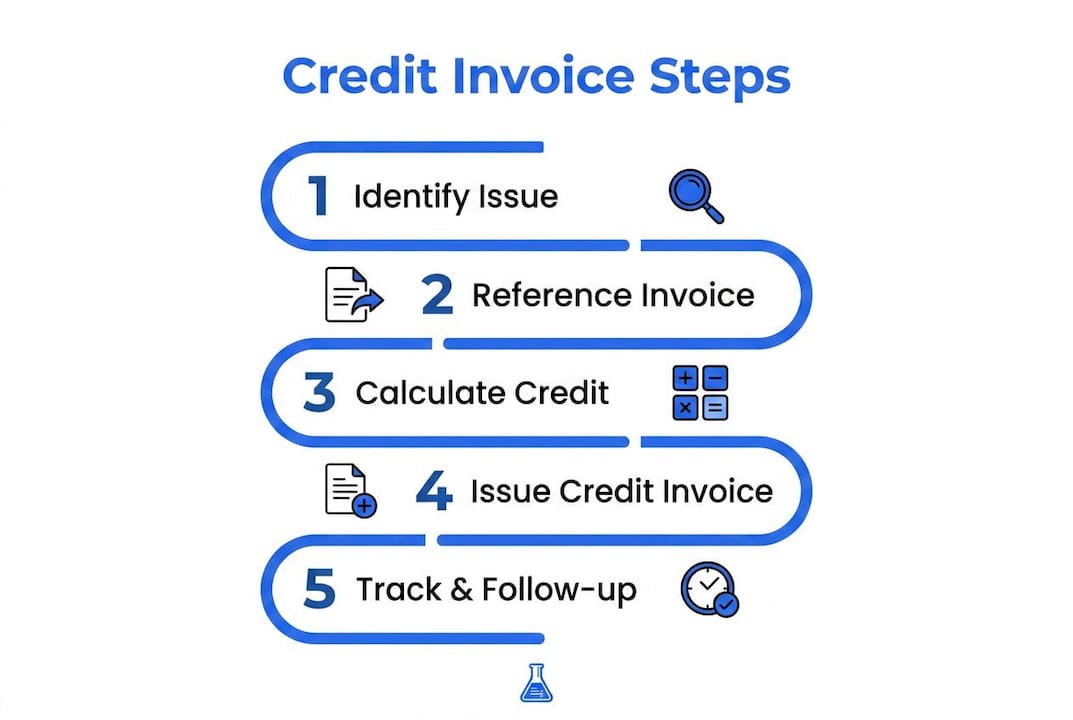
How to write a credit invoice, step by step
Creating a credit invoice correctly takes about five minutes when you know the process.
- Pull up the original invoice. Note its number, date, line items, quantities, unit prices, and tax rates. Everything on the credit invoice flows from this document.
- Assign a unique credit invoice number. Use a separate sequence from your invoices. CN-2026-001 is a clean, recognizable format.
- Enter the reference. Add a dedicated field: “Credit applied against Invoice #INV-2026-047, dated March 3, 2026.”
- List the credited line items. Copy the exact descriptions from the original invoice. Show quantities as negative numbers or clearly label them as credits. Do not round or combine lines.
- Calculate and show tax reversals. For each credited line, apply the same tax rate and show the tax credit on a separate line. The total credit equals the net credit plus the tax credit.
- State the reason. One clear sentence in a dedicated field. “Customer returned one unit of Advanced Optical Sensor due to shipping damage.”
- Send it promptly. The customer needs the credit invoice to adjust their own accounts payable records. Delays create mismatches between your receivables and their payables.
Pro Tip: Using invoice software with templates built for credit invoices eliminates manual calculation errors and automatically links the credit to the original invoice number, which is the step most people get wrong.
Credit invoice examples and template formats
A practical credit invoice example helps more than a list of rules. Here is how a typical credit invoice looks in structured form:
| Field | Example Value |
|---|---|
| Document title | Credit Invoice / Credit Note |
| Credit invoice number | CN-2026-001 |
| Issue date | March 2026 |
| Original invoice reference | INV-2026-xxx, dated February 2026 |
| Customer name | Hartwell Design Studio |
| Credited item | Logo design revision (2 hrs) |
| Net credit | — |
| Sales tax reversed | — |
| Total credit | — |
| Reason for credit | Overbilling: 2 hours charged in error |
Partial credit example: A freelance photographer invoiced a client for five edited images at $200 each ($1,000 total). The client received only three. The credit invoice covers two images: ($400.00) net plus tax, referencing the original invoice, with the reason “two images not delivered per revised project scope.”
Full credit example: A consultant invoiced for a project that was cancelled before any work began. The credit invoice mirrors the entire original invoice with all amounts shown as negative, bringing the balance to zero. The reason line reads: “Project cancelled prior to commencement, per client email dated March 10, 2026.”
For ready-to-use formats, profession-specific templates cover common use cases for freelancers, consultants, and small businesses, with fields for original invoice reference and tax reversal already built in.
Legal and accounting implications of credit invoices
Deleting or editing an issued invoice is a violation of GAAP and IFRS accounting principles. A credit invoice is the legally correct mechanism to neutralize a charge while keeping both documents on file. This matters because tax authorities audit invoice sequences: a missing number or an unexplained gap triggers scrutiny.
On the balance sheet, a credit invoice reduces accounts receivable by the credited amount. If sales tax was collected on the original invoice, the credit invoice reduces your tax liability by the same proportion. Your accountant records the credit invoice as a debit to revenue and a credit to accounts receivable, reversing the original entry for the affected lines.
For US businesses, the IRS expects consistent, traceable records. A credit invoice that references the original invoice number satisfies that requirement. One that does not creates an orphan credit, which auditors treat as a potential underreporting of income until proven otherwise. Consulting a tax advisory service before your first audit is a practical way to confirm your recordkeeping approach holds up.
Best practices for sending and tracking credit invoices
Send the credit invoice as soon as the triggering event is confirmed, not at the end of the month. The customer’s accounts payable team needs it to reconcile their records, and delays create mismatches that both sides spend time resolving.
Number every credit invoice sequentially and never skip or reuse numbers. Keep the credit invoice and its original invoice stored together, either in your accounting software or in a linked folder structure. When a customer disputes a balance, being able to pull both documents in seconds resolves the conversation quickly.
Follow up if the credit invoice is not acknowledged within a few business days. In B2B transactions, an unacknowledged credit can sit unprocessed in a customer’s inbox while their accounts payable team continues to show the full original balance as outstanding. A brief email confirmation closes that loop.
Track open credits separately from open invoices. A credit that has been issued but not yet applied to a future invoice or refunded is still a liability on your books. Reviewing open credits monthly prevents them from aging into accounting confusion.
How to handle credit invoices in accounting software
Most accounting platforms let you create a credit memo or credit note directly from the original invoice record, which automatically populates the reference number, line items, and tax rates. This is the fastest path and the one least likely to introduce errors.

If you are creating credit invoices manually or using a general invoicing tool, the key is to link the credit to the original invoice in the software’s transaction records, not just on the printed document. Software that tracks invoice status will then show the original invoice as partially or fully credited, keeping your receivables dashboard accurate.
Automated invoice software also handles the journal entries automatically: debiting revenue and crediting accounts receivable for the credited amount, and adjusting the tax liability account for the reversed tax. Doing this manually is error-prone, especially when partial credits span multiple tax rates.
For freelancers and small businesses who want a fast, compliant starting point, Invoicelabs offers a free invoice generator that supports quick document creation with real-time tax calculations, making it straightforward to produce a properly formatted credit invoice without building one from scratch.
Key Takeaways
A credit invoice formally reduces a prior invoice’s balance without deleting the original, and every compliant version requires a unique number, an original invoice reference, exact line item mirroring, and a stated reason for the credit.
| Point | Details |
|---|---|
| Never edit issued invoices | Issue a credit invoice instead; deleting invoices violates GAAP and IFRS and creates audit gaps. |
| Unique numbering is required | Use a separate sequence (e.g., CN-2026-001) and never reuse or borrow from your invoice numbering. |
| Reference the original invoice | Always include the original invoice number and date to avoid orphan credits that fail tax audits. |
| Mirror line items exactly | Credit the specific lines that changed, using identical descriptions and the same tax rate as the original. |
| Credit vs. refund distinction | A credit invoice reduces the balance on paper; a refund returns actual cash and is a separate transaction. |
Recommended
Send your next invoice in seconds
Create professional invoices, track payments and get paid faster — free to start.