Turn 2% Into a 37% Return: Early Payment Discounts for Small Teams
An early payment discount is a small percentage price cut, typically between 1% and 3%, that a seller offers when a buyer pays an invoice well before its normal due date. You’ll see it written as shorthand like 2/10 Net 30, meaning 2% off if paid within 10 days on a 30 day invoice. The rule of thumb: take it if the annualized return beats your cost of borrowing and your cash flow can absorb the early outflow; skip it if cash is tight or the return is marginal.
TL;DR:
- Early payment discounts typically range from 1% to 3% for payments made within 10 to 15 days, but operational delays can nullify these benefits.
- The chance to capture the discount hinges on fast invoicing, approval, and payment processing, as delays at any stage prevent discount realization.
- Suppliers prefer fixed, static discounts for simplicity, while sliding scale and dynamic discounts offer more flexibility based on early payment timing.
- Buyers should run an annualized return calculation to determine if paying early makes financial sense compared to their cost of capital, considering liquidity.
- Faster invoicing and clear disclosure of terms significantly increase the likelihood of capturing early payment discounts, especially for small teams.
Table of Contents
- What Is an Early Payment Discount on an Invoice?
- How Early Payment Discounts Work in Practice
- Static, Sliding Scale, and Dynamic Discount Types
- Who Benefits More: Buyers or Sellers?
- How to Decide: The Annualized Return Method
- Recording Early Payment Discounts: Gross vs. Net Method
- Capturing More Discounts: A Workflow That Actually Works
- Quick Takeaways and Action Checklist
- What Most Advice on Early Payment Discounts Gets Wrong
- Sources
What Is an Early Payment Discount on an Invoice?
An early payment discount, sometimes called a prompt payment discount or cash discount, is a price reduction a supplier builds into invoice terms to reward faster payment. It’s not a favor. It’s a financing tool. The seller trades a slice of margin for cash sooner and less risk of the invoice going unpaid.
The notation looks cryptic until you decode it. 2/10 Net 30 means the buyer gets 2% off if they pay within 10 days, otherwise the full amount is due in 30 days. You might also see 1/15 Net 45 or 3/10 Net 60. The first number is always the discount rate. The second is the discount window. “Net” plus the final number is the standard due date.
Typical structures worth knowing:
- Most common discount range: 1% to 3% off the invoice total
- Most common discount window: 10 to 15 days from the invoice date
- Standard terms discount windows sit well inside net 30, net 45, or net 60 due dates
- Some industries stretch the discount to 20 days on longer net 60 or net 90 terms
Suppliers who use consistent payment terms across invoices tend to see more predictable uptake, because buyers know exactly what they’re comparing before they decide whether to pay early.
How Early Payment Discounts Work in Practice
The discount only gets captured if the operational timeline holds up, and that timeline has more moving parts than the notation suggests.
- Invoice issuance. The seller sends the invoice immediately after delivering goods or services, with the discount terms clearly printed. A delay here eats into the buyer’s discount window before they’ve even opened the email.
- Buyer receipt and approval. The invoice has to clear the buyer’s internal approval chain fast enough to leave time for payment processing. This is where most discounts die. If approval takes eight days on a 10 day window, there’s no runway left.
- Payment execution. The buyer initiates payment, and the clock stops on the date the seller actually receives funds, not the date the buyer clicks “send.” Bank transfers and check mail time both eat into the window.
- Reconciliation. The seller confirms the discounted amount matches what was actually paid and adjusts accounts receivable accordingly.
This chain directly affects Days Sales Outstanding, the average number of days it takes a company to collect payment after a sale. Early payment discounts lower DSO by pulling cash forward, which matters more to sellers with thin working capital than to those sitting on reserves. On the buyer side, the bottleneck is almost always internal approval speed, not willingness to pay.
Static, Sliding Scale, and Dynamic Discount Types
Early payment discounts generally fall into three structural categories, and picking the right one depends on how much flexibility a seller wants to build in.
Static discounts offer one fixed percentage for one fixed window. A $5,000 invoice under 2/10 Net 30 saves the buyer $100 if paid within 10 days. Simple to administer, easy for buyers to evaluate, and the most common format by far.
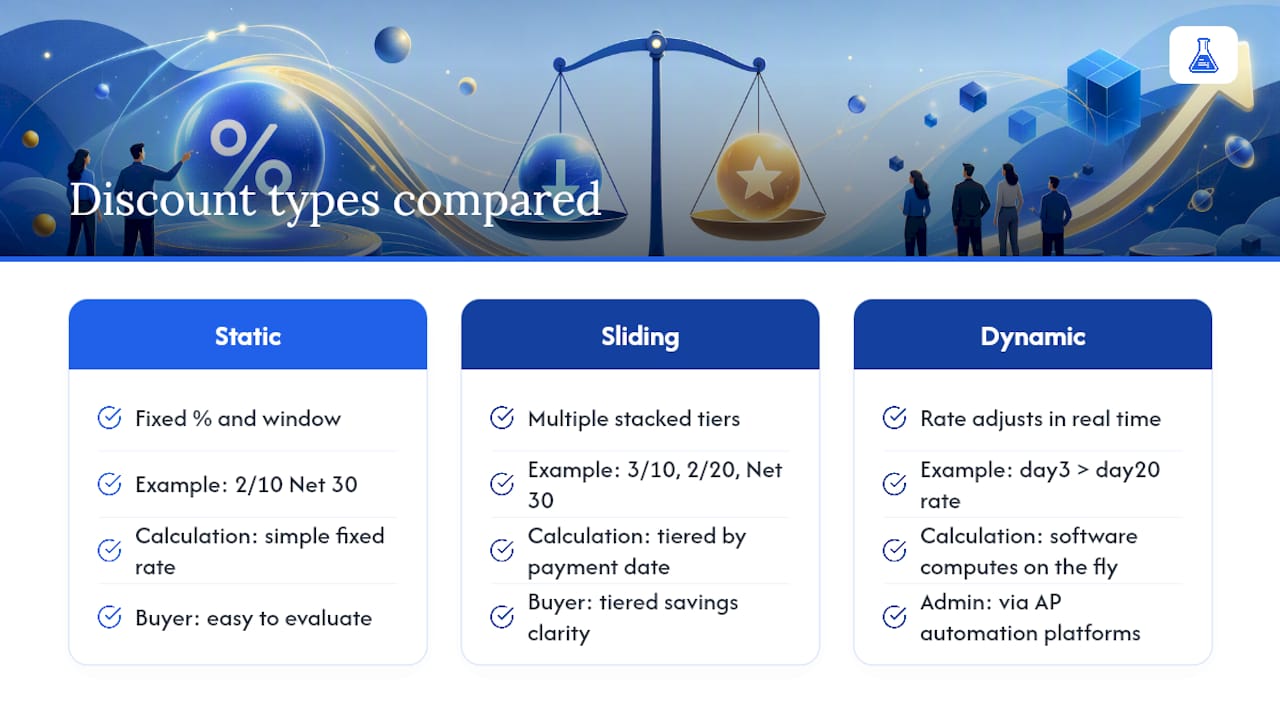
Sliding scale discounts stack multiple tiers into a single invoice. Terms might read 3/10, 2/20, Net 30: 3% if paid within 10 days, 2% if paid between day 11 and 20, and full price after that. A $10,000 invoice would save $300 paid on day 8, or $200 paid on day 15.
Dynamic discounts adjust in real time based on how early the buyer pays, often calculated automatically through AP automation platforms rather than fixed in the original terms. A buyer paying on day 3 of a 30 day term might get a slightly better rate than one paying on day 20, with the software computing the exact figure on the fly.
Static discounts remain the dominant model outside large enterprise supply chains, and institutional finance offices lean on them heavily. The University of Bradford’s tuition discount scheme is a clean real-world example: pay fees early and receive a fixed percentage reduction, no tiers, no negotiation.
Who Benefits More: Buyers or Sellers?
Both sides gain something, but they’re not gaining the same thing, and that asymmetry is why negotiations over discount terms can get tense.
- Buyers reduce their total spend and can improve vendor relationships, but they trade liquidity for savings. Paying $9,800 today instead of $10,000 in 30 days only makes sense if that cash isn’t needed more urgently elsewhere.
- Sellers get faster access to cash and lower the risk of nonpayment or bad debt, which is often worth more than the discount costs in avoided collections work and reduced borrowing needs.
- Buyers with tight cash reserves should generally skip discounts even when the math looks attractive on paper. A missed payroll or supplier default costs far more than a 2% savings.
- Sellers with long DSO problems should prioritize offering discounts aggressively, since shortening the collection cycle usually helps more than the margin hit hurts.
The trade-off is straightforward once you separate margin from cash. A discount that shaves 2% off revenue but shortens collection by 20 days is often a better deal than it looks on the income statement alone.
How to Decide: The Annualized Return Method
The math behind an early payment discount decision is simple once you convert the discount rate into an annualized figure, because a 2% discount for paying 20 days early is a much bigger deal than 2% sounds.
- Calculate the discount amount. Invoice total multiplied by the discount rate. A $10,000 invoice at 2% saves $200.
- Find the annualized return. Use the formula: (Discount % ÷ (100% minus Discount %)) × (365 ÷ (Full term days minus discount period days)). For 2/10 Net 30: (2 ÷ 98) × (365 ÷ 20) = roughly 37% annualized.
- Compare against your cost of capital. If you’re borrowing at 10% to fund early payment, a 37% annualized return easily clears that bar. If your line of credit costs 40%, it doesn’t.
- Weigh liquidity against return. The comparison should always run against your actual cost of borrowing or the return you’d earn leaving cash where it is, not against an abstract benchmark.
Before pulling the trigger, run a quick checklist: confirm the invoice amount and dates are accurate, confirm you have the cash on hand without straining other obligations, and confirm the supplier has a track record of honoring the terms as written, as explained in this balancing payment self assessment. Miss any one of those and the “discount” can turn into an unnecessary cash squeeze.
Recording Early Payment Discounts: Gross vs. Net Method
Bookkeeping treatment depends on which of two standard methods a business uses, and the choice affects how accounts payable and receivable look before a discount is even taken.
- Gross method: Record the full invoice amount first, then adjust with a separate entry if the discount is taken. If a buyer pays $980 on a $1,000 invoice with a 2% discount, the entry is a debit to cash for $980, a credit to accounts payable for $1,000, and a credit to purchase discounts for $20, per NetSuite’s standard example.
- Net method: Record the invoice at the discounted amount up front, assuming the discount will be taken. If it isn’t, a separate “discounts lost” entry captures the difference.
- Seller side: Mirrors the buyer’s entries with sales discounts instead of purchase discounts, reducing gross revenue on the income statement.
- Tax and VAT treatment varies by jurisdiction and by whether the discount is applied before or after tax calculation on the invoice. Gross versus net accounting for 2/10 Net 30 terms is well documented, but confirm the specific treatment with a local tax advisor before setting policy.
Capturing More Discounts: A Workflow That Actually Works
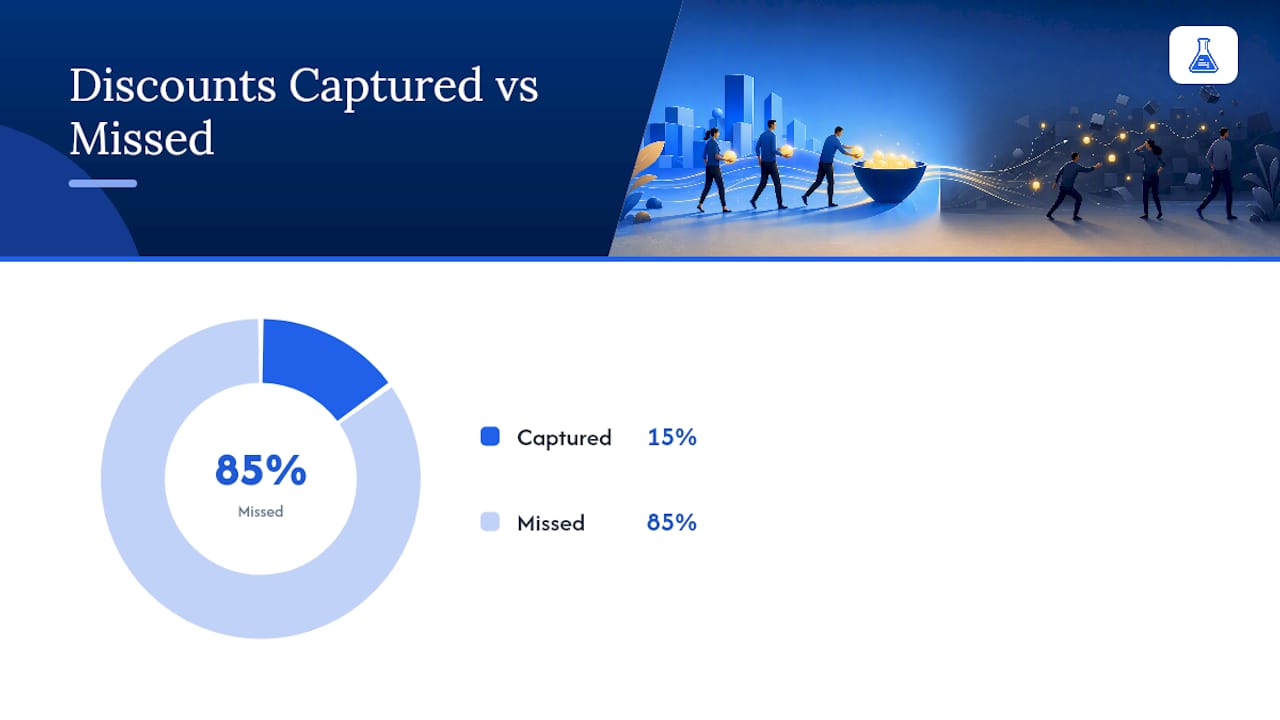
Capturing an early payment discount consistently comes down to speed at every step, not luck. The median organization pays 96% of invoices on time but captures discounts on only about 15% of eligible invoices, almost always because manual approval chains eat the discount window before payment even starts.
A few habits close that gap fast:
- Send invoices the same day work is delivered, not the following week, so the discount clock starts with maximum runway.
- State the discount terms in plain numbers on the invoice itself, not buried in a payment policy PDF nobody reads.
- Route approvals through a defined workflow with named owners instead of an email chain that stalls when one person is out.
- Set automated payment reminders a few days before the discount deadline, not after it’s already passed.
- Reconcile discounted payments against the original invoice immediately, so disputes over “did they pay the right amount” don’t linger.
Pro Tip: If a client misses the discount deadline by even one day, the discount is typically forfeited outright, so track the actual payment receipt timestamp, not the date the buyer says they sent it, to avoid arguments later.
Small teams without a dedicated AP department can close most of this gap just by sending clean, itemized invoices instantly and tracking payment status in real time rather than relying on memory or a spreadsheet.
Quick Takeaways and Action Checklist
If you’re the one paying: run the annualized return calculation, confirm you have cash to spare, and pay early only when the math and your liquidity both say yes. If you’re the one billing: state discount terms clearly on the invoice, send it the moment work is done, and track how often clients actually use the discount so you know if it’s earning its keep. Either way, check the accounting treatment with a tax advisor before locking in a policy.
| Role | First Action | Second Action | Ongoing Check |
|---|---|---|---|
| Buyer | Calculate annualized return | Confirm cash runway | Compare against borrowing cost each time |
| Seller | State terms clearly on invoice | Send invoice same day | Monitor discount uptake rate |
What Most Advice on Early Payment Discounts Gets Wrong
Most guides treat the early payment discount decision as pure math: calculate the annualized return, compare it to your cost of capital, done. That’s necessary but not sufficient. The bigger failure point isn’t the calculation. It’s operational speed. A supplier can offer a fantastic 2/10 Net 30 term, and a buyer can want to take it, and the discount still evaporates because an invoice sat in an approval inbox for nine days.
The conventional advice underrates how much of this comes down to invoicing hygiene long before any financial decision gets made. A clear invoice sent the same day work wraps, with the discount terms spelled out in plain numbers, gives both sides a real shot at capturing value that manual, delayed billing simply forfeits. Freelancers and small teams especially should stop treating the discount decision as a finance problem and start treating it as a workflow problem: fix the speed of invoicing and approval first, then worry about the annualized return math. The rate calculation matters. The plumbing that gets you there in time matters more.
— Black Flame Digital
Sending invoices the moment work is finished, with terms stated plainly and payment tracked automatically, is exactly the kind of groundwork that determines whether a discount gets captured or quietly missed. InvoiceLabs’ quick invoice generator creates a professional, itemized invoice in under 30 seconds, complete with real-time tax calculations and instant delivery, so the discount clock starts working in your favor instead of against you.
This article is general information, not a substitute for advice from a qualified financial advisor. Consult a qualified financial professional about your own circumstances before acting on anything here.
Sources
- Early Payment Discounts: Definition, Types, & Examples
- Net payment terms: benefits of net 30/60/90 terms
- What Is an Early Payment Discount? | NetSuite
- Early payment discount scheme - Tuition fees
Recommended
Send your next invoice in seconds
Create professional invoices, track payments and get paid faster — free to start.