Send a Web Developer Invoice in Under a Minute That Holds Up
A correct web developer invoice includes your business and client details, an invoice number, issue and due dates, itemized deliverables or milestones, tax, totals, and clear payment terms with a way to pay instantly. Skip the blank Word document. Grab a web developer invoice template or run a quick invoice through a tool built for it, and you can have one out the door in under a minute.
TL;DR:
- Use clear milestone labels tied to specific deliverables rather than vague progress descriptions to avoid payment disputes.
- Incorporate explicit change request and pass-through cost lines with references to approval, receipts, or invoices to prevent scope creep.
- Choose the right invoice format, such as PDF with branded branding and detailed line items, to ensure professionalism and ease of dispute resolution.
- Accept fast payment methods like card payments via Stripe and embedded payment links to reduce delays and improve cash flow.
- Maintain consistency with invoice numbering, tracking statuses automatically, and following a strict handoff protocol to minimize late payments.
Table of Contents
- What Belongs on a Web Developer Invoicing Document?
- Choosing a Billing Model: Milestones, Hourly, or Retainer
- How to Bill Scope Changes and Pass-Through Costs
- Which Invoice Format Should You Actually Use?
- Which Payment Methods Actually Get You Paid Faster?
- The Invoicing Mistakes That Quietly Cost You Money
- How InvoiceLabs Puts This Into Practice
- An Editor’s Take on Getting Paid Without the Chase
- Send Your Next Invoice in Under a Minute
- Sources
What Belongs on a Web Developer Invoicing Document?
Every field on a web development invoice exists to prevent a specific argument later. Miss one, and you’re the one chasing an explanation instead of a payment.
Start with the basics: your business name, address, and contact info, plus the client’s billing contact and company name. If you’re invoicing a company rather than the person you emailed with, get the legal entity name right, because that’s what their accounts payable team will match against a purchase order.
A unique invoice number is not busywork. It’s how you and your client both track which invoice paid for what, and it’s what you’ll need if you ever get audited on VAT or sales tax records. Sequential numbering (INV-2026-014, for example) beats dates alone because two invoices can share a date but never a number.
Issue date and due date are separate fields, not one line. If you’re billing a client in another country, spell out the date format (March 12, 2026, not 3/12/26) and state the currency explicitly, especially if you invoice in a currency different from your own.
The line items are where most invoices fall apart. According to Wave’s breakdown of web development invoice fields, a professional invoice needs the milestone or feature name, a short scope reference, quantity or hours, unit rate, and a line subtotal, not just “development work, $3,000.”
A tight invoice includes:
- Milestone or deliverable name tied to something the client can see (not “50% done”)
- Hours or quantity, plus your rate, shown separately from the subtotal
- A VAT or sales tax line, with both the tax-exclusive and tax-inclusive totals displayed
- Payment terms (Net 15, Net 30) and any late fee percentage
- Bank details or a payment link, never buried in a follow-up email
- A reference to the contract or statement of work, plus any change-request numbers tied to that invoice
That last point matters more than people think. If a line item traces back to CR-3 in your contract, nobody can argue later that the work wasn’t approved.
Choosing a Billing Model: Milestones, Hourly, or Retainer
Your billing model decides how often you get paid and how much leverage you have when a client goes quiet. Get it wrong and you’re either invoicing too rarely to make payroll on yourself, or too often for the client to tolerate.
- Fixed-price milestones. This works best for defined-scope builds: a marketing site, a straightforward e-commerce store, an MVP with a fixed feature list. A common split is a deposit at kickoff, another payment when the build hits staging, and a final payment at launch. Milestone billing tied to observable deliverables like “design approved” or “staging complete” gives both sides a concrete trigger for payment instead of a vague progress percentage. Build in an acceptance window, typically 3 to 5 business days, so a client can’t sit on a milestone indefinitely while your invoice ages.
- Hourly and sprint billing. Better for ongoing feature work or anything with shifting requirements. Summarize hours by feature or sprint rather than a single “development” line, and pick a cadence: weekly for high-touch projects, biweekly or monthly for steadier ones. Clients tolerate detailed hourly invoices far better than vague ones.
- Retainers. These fit maintenance and support relationships. Invoice in advance for a defined block of hours, then show included hours used versus overflow hours billed at your standard rate. If your retainer covers 10 hours a month and the client used 14, the invoice should show 10 hours included and 4 hours at the overflow rate, not one blended number.
If you took a deposit, credit it explicitly on the next invoice rather than just reducing the total silently: show “Deposit received: $1,500” as its own line, so the math is visible.
How to Bill Scope Changes and Pass-Through Costs
Scope creep only costs you money when it’s invisible on the invoice. The fix is a labeling system, not a longer conversation with the client.
Give every change request its own identifier: CR-1, CR-2, and so on. Reference the approval, whether that’s a signed change order, a dated email, or a message thread, directly on the invoice line. Show the CR’s quoted amount as its own line item, separate from the original scope, so the client sees exactly what they approved and what it cost.
A clean line might read: “CR-2: Add multi-language support (approved via email, Feb 3, 2026) — $850.” That single line does more to prevent a payment dispute than any clause buried in your contract.
Third-party costs work the same way. If you paid for premium hosting, a paid plugin license, or an API subscription on the client’s behalf, list it as a named pass-through line, not folded into your labor rate:
- “Pass-through: Premium hosting upgrade (receipt attached) — $120”
- “Pass-through: Third-party API license, annual (invoice #4471 attached) — $299”
Attach the receipt or vendor invoice as a PDF whenever you can. It removes any ambiguity about markup and keeps your own bookkeeping clean.
If your contract requires written approval for scope changes, cite the clause number directly on the invoice (“per Section 4.2 of SOW”) so the paper trail is airtight if a client ever pushes back weeks later. Invoice templates that build in explicit CR lines and pass-through sections turn scope creep into something you get paid for instead of something you quietly absorb.
Which Invoice Format Should You Actually Use?
Format matters more than freelancers give it credit for. The wrong one either looks unprofessional or creates extra work down the line.
Editable formats like Word or Google Docs work well when a client wants to review or annotate before approving. Spreadsheet formats, Excel or Google Sheets, are better when you’re tracking multiple line items across a long project and want formulas doing the tax math for you. PDF is the format you actually send. It’s locked, looks consistent across devices, and templates for web development invoices are commonly distributed in all four formats so you can draft in one and deliver in another.
Before you send anything, customize these fields so the invoice looks like it came from a real business, not a downloaded file:
- Your logo and brand colors, if you have them
- Full business and banking details, including your VAT or tax ID if applicable
- A direct reference to the SOW or CR number tied to this specific invoice
- A payment link or clear bank transfer instructions, not just “payment due upon receipt”
The fast workflow looks like this: pick a template, fill in the core fields, attach your SOW or CR references, drop in a payment link, then send and track the status. That’s it. InvoiceLabs’ web developer template is built around exactly that structure, and its quick invoice generator skips the account setup entirely if you just need to bill a client right now.
Quick fact: Templates that separate hours, unit rate, and subtotal as distinct columns, rather than one lump figure, make it dramatically easier to defend a bill if a client questions a specific line, and they cut the back-and-forth to a single email instead of a phone call.
Which Payment Methods Actually Get You Paid Faster?
The payment method you offer matters almost as much as the invoice itself. A beautifully formatted invoice with no easy way to pay just sits in someone’s inbox.
- Card payments via Stripe. Fastest option for most clients, especially smaller ones paying out of pocket rather than through an accounts payable department. Fees apply, but the speed usually outweighs the cost.
- Bank transfer. Still the default for larger companies with formal payment processes, but slower, often tied to their own internal Net 30 or Net 60 cycle regardless of what your invoice says.
- Reusable payment links. Some freelancers skip formal invoicing entirely for smaller repeat clients using reusable payment links, though this works best for simple, recurring charges rather than itemized project work.
Pair that with automatic status tracking, so you know the moment an invoice is viewed, not just when it’s paid.
Pro Tip: Set your reminder cadence before you send the invoice, not after it’s overdue. A reminder at the due date, then again 7 days later, feels routine. The same reminder sent for the first time three weeks late feels desperate, even when the amount owed hasn’t changed.
The Invoicing Mistakes That Quietly Cost You Money
Most invoicing losses aren’t dramatic. They’re small habits that compound over a year of projects.
- Billing vague progress instead of observable milestones. “50% complete” invites debate. “Design approved by client” doesn’t.
- Handing over final files before final payment clears. State plainly in your contract: “Final deliverables, source files, and hosting credentials transfer upon receipt of final payment.” No exceptions, no informal handoffs as a gesture of good faith.
- Skipping the approval step on change requests. The sequence should always be quote, then written approval, then invoice line, in that order, never invoice first and approval as an afterthought.
- Inconsistent or missing invoice numbers. This creates real problems come tax season and makes any payment dispute harder to resolve, since you can’t point to a clean paper trail.
- No system for tracking which invoices are paid, pending, or overdue. A spreadsheet works. A tool that tracks status automatically works better, since it removes the manual follow-up step you’re most likely to forget.
How InvoiceLabs Puts This Into Practice
Everything above is easier to apply with the right template already in front of you instead of building one from scratch.
InvoiceLabs’ web developer template has the milestone, tax, and payment-term fields already structured, so you’re filling in project specifics instead of designing a layout. Pair it with the quick invoice generator, which lets you create and send an invoice in under a minute, accountless, with Stripe payment collection built in.
A few things that save real time on every project:
- Real-time tax calculation, so VAT-inclusive and VAT-exclusive totals update automatically as you edit line items
- Invoice status tracking, so you see the moment a client opens the invoice instead of guessing
- Branded PDFs with your logo and colors, so a retainer client sees consistency across every monthly invoice
The details on record-keeping and VAT-friendly formatting are worth a closer look in InvoiceLabs’ freelancer invoicing guide if you’re setting up your invoicing system for the first time this year.
An Editor’s Take on Getting Paid Without the Chase
The whole system boils down to one habit: bill against things a client can see, not percentages they have to trust you on, and never release final work before final payment clears. Every dispute over a web development invoice traces back to one of those two rules being skipped.
The developers who get paid fastest aren’t the ones with the best contracts. They’re the ones who apply the same terms, the same numbering, and the same handoff rule to every client, every time, without exception for the client who seems nice or the project that started as a favor. Consistency is what makes a late fee stick and a scope-change line hold up when someone pushes back.
— Black Flame Digital
Send Your Next Invoice in Under a Minute
You’ve seen what a defensible web developer invoice needs: clean milestones, tax handled correctly, and a payment method that doesn’t make the client work for it. InvoiceLabs builds all of that into one workflow instead of leaving you to assemble it across a spreadsheet, a PDF export, and a separate payment app.
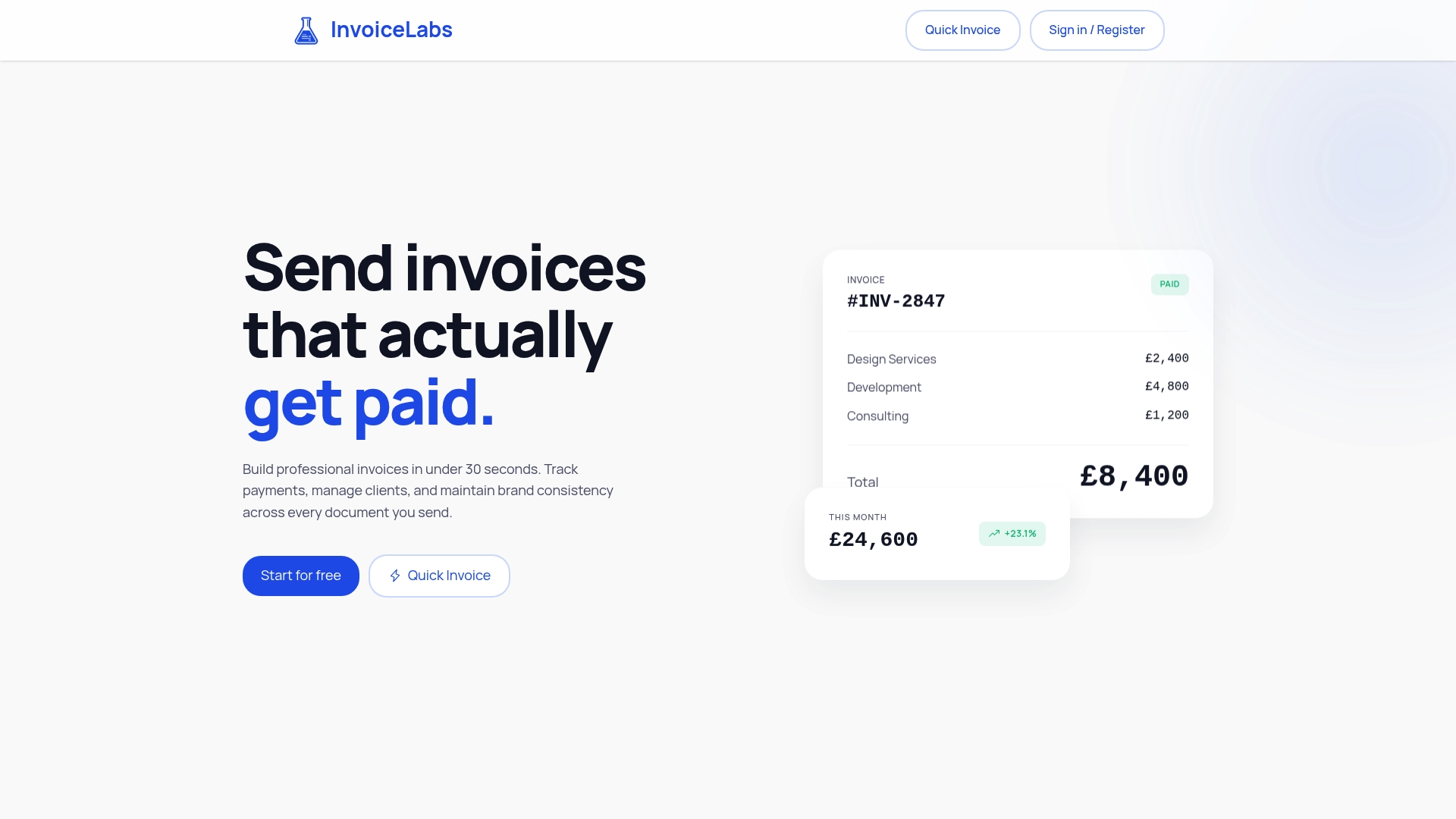
Pick the free invoice template for web developers and it already has your milestone and tax fields structured. Need to bill a client right now, no account setup, no delay? The quick invoice generator creates a branded PDF with Stripe payment collection built in, so the client can pay the moment they open it. Real-time tax calculation and invoice-status tracking come standard, which means fewer spreadsheets and fewer “did they pay yet?” moments.
Open the quick invoice tool and send your next one before this project’s coffee gets cold.
Sources
Recommended
Send your next invoice in seconds
Create professional invoices, track payments and get paid faster — free to start.