Cut Audit Risk: Invoice vs Receipt Checklist for Small Businesses
An invoice asks for payment; a receipt proves the payment happened. Issue an invoice before the money arrives and a receipt after. If you only have the bandwidth for one document, mark the invoice “Paid” with the date, method, and a transaction reference, and it can double as your receipt.
TL;DR:
- An invoice acts as a formal request for payment issued before receiving funds, while a receipt confirms that payment has already been made.
- Linking invoice numbers with transaction IDs and storing both documents together simplifies VAT compliance and reduces reconciliation errors.
- Digital receipts and e-invoicing are standard, but incomplete documents lacking key details can weaken their legal and tax validity.
- For online sales, a payment confirmation email often isn’t enough without explicit purchase descriptions and seller details.
- Invoices and receipts serve different legal purposes: invoices prove a debt exists, while receipts verify that payment has been completed.
Table of Contents
- Invoice vs Receipt: What an Invoice Actually Is
- Invoice vs Receipt: What a Receipt Confirms
- Invoice vs Receipt at a Glance
- When to Issue Each Document: A Practical Workflow
- Invoice vs Receipt for VAT and Bookkeeping
- Copy-Ready Invoice and Receipt Checklists
- Can an Invoice Replace a Receipt?
- Legal Implications and Validity of Invoices Versus Receipts
- Paper, PDF, and E-Invoicing: How Format Has Changed
- How Invoices and Receipts Work Across Industries
- Fixing Mistakes on Invoices and Receipts
- Invoicing and Receipts Around the World
- What Actually Reduces Disputes
- Get Your Invoicing and Receipts Handled in One Step
- Sources
Invoice vs Receipt: What an Invoice Actually Is
An invoice is a formal request for payment, sent before you get paid, and it’s what creates accounts receivable on your books the moment you send it. Whether you’re billing a client for a finished logo or a month of consulting hours, the invoice is the document that says “here’s what you owe and by when.”
A usable invoice needs these fields:
- Your business name, address, and contact details, plus the client’s
- A unique invoice number and issue date
- A due date and clear payment terms
- Line items with quantities, unit prices, and totals
- VAT or tax breakdown, if you’re VAT registered
- Payment methods accepted and where to send funds
Not every invoice looks the same. A pro forma invoice is a preview sent before work begins, often for customs or upfront approval. A standard invoice requests payment for delivered work. Recurring invoices fire automatically on a schedule for retainer clients or subscriptions. Credit and debit notes adjust an invoice after the fact, when you’ve overcharged, undercharged, or issued a refund. Picking the right type matters more than most freelancers assume, especially once a client’s accounts payable team starts asking questions.
Invoice vs Receipt: What a Receipt Confirms
A receipt is proof that payment already landed, issued after the transaction closes rather than before it. Where the invoice creates a claim on money owed, the receipt marks the moment that claim gets settled and typically triggers income recognition in your books.
A solid receipt includes:
- The date payment was received
- The amount paid and the currency
- Payment method (card, bank transfer, cash)
- A transaction or reference ID
- A short description of what was purchased
- Seller name and contact information
Digital receipts have mostly replaced paper slips for service businesses. PDF receipts emailed after a Stripe charge, point-of-sale printouts at a retail counter, and automated confirmation emails all count, provided they carry the fields above. One catch: a bare payment processor confirmation email (just “$450 charged to card ending 4471”) often isn’t enough on its own. It’s missing the description of goods or services and sometimes the seller’s registered business details, both of which matter if a customer needs the receipt for expense reporting or a warranty claim.
Invoice vs Receipt at a Glance
The fastest way to keep these straight is to compare them side by side across the four things that actually matter for bookkeeping.
| Aspect | Invoice | Receipt |
|---|---|---|
| Timing | Issued before payment | Issued after payment |
| Purpose | Requests payment | Confirms payment |
| Typical contents | Line items, due date, payment terms, VAT breakdown | Amount paid, payment method, transaction ID |
| Accounting treatment | Creates accounts receivable | Recognizes income |
| Common scenario | Freelance project billing, deposits | Retail sale, completed online order |
A few things to remember when you’re staring at both documents during reconciliation or a dispute:
- The invoice tells you what was promised; the receipt tells you what was delivered financially.
- If a client disputes a charge, the receipt is your evidence the money moved, but the invoice is your evidence of what was agreed.
- Mismatched totals between the two are the single most common flag during a VAT review, so keep them numerically identical unless a credit note explains the gap.
When to Issue Each Document: A Practical Workflow
Different business models trigger these documents at different points, and mixing up the order is one of the more common invoicing mistakes small operators make.
- Point-of-sale retail: issue a receipt at the moment of sale. No invoice is necessary unless the customer specifically requests one for expense purposes.
- Freelance or agency projects: send an invoice at project milestones or on completion, then issue a receipt once the payment actually clears.
- Deposits and staged payments: issue a separate invoice for each stage of the project, and a matching receipt every time a payment comes in.
- Recurring or subscription billing: treat each invoice as a fresh request tied to the billing cycle, and generate a receipt per payment so your reconciliation trail stays clean month over month.
Pro Tip: If you invoice on Net 30 terms, don’t wait until the due date to check for payment. Reconcile weekly. A receipt that shows up three weeks after the invoice date is far easier to match to the right line item than one you’re chasing down after a quarter has closed.
Invoice vs Receipt for VAT and Bookkeeping
Invoices land in accounts receivable the day they’re issued; receipts land in recognized income the day money actually clears. That timing gap is exactly why bookkeeping software asks for both, not just one.
If you’re VAT registered, a VAT invoice needs extra detail: your VAT registration number, the VAT rate applied per line item, and the total VAT charged separately from the net amount. For business-to-business transactions, a properly detailed VAT invoice can be mandatory for the buyer to reclaim VAT, so skipping the breakdown can cost your client money and cost you a follow-up email.
Keeping invoices and receipts filed together is repeated advice across accounting guidance for a good reason: it simplifies VAT returns and audits, because a reviewer can trace a request straight through to its payment without chasing separate records. When you’re reconciling digitally, match transaction IDs from your payment processor against your invoice numbers. That single habit catches double payments and missed invoices faster than any manual spreadsheet check.
- Invoice number and transaction ID should always cross-reference each other
- Store both documents under the same client folder or tag, not separate systems
- Review unpaid invoices against your receipt log weekly, not monthly
Copy-Ready Invoice and Receipt Checklists
Templates save time, but only if they force you to include the fields that actually get checked later.
Invoice checklist:
- Invoice number (e.g., INV-2026-014)
- Issue date and due date
- Line items with description, quantity, rate, total
- Payment terms (e.g., “Net 15” or “Due on receipt”)
- VAT number and rate, if applicable
Receipt checklist:
- Payment date and amount
- Payment method and last four digits, if card
- Transaction reference ID
- Short line describing the service or product
- Confirmation the invoice number it settles
For file naming, keep it consistent: 2026-03-invoice-001-clientname.pdf and 2026-03-receipt-001-clientname.pdf sort cleanly and search easily. Most tax authorities expect records kept for several years, so archive both in cloud storage with automatic backup rather than a folder on one laptop. A ready-made structure like an invoicing guide for freelancers and small businesses can save you from rebuilding this from scratch every quarter.
Can an Invoice Replace a Receipt?
Yes, in many cases. Marking an invoice “Paid” and adding the payment date, method, and transaction reference turns it into a valid proof of payment for most bookkeeping purposes. Labeling it “Paid” without those specifics weakens its value considerably; a customer or auditor has no way to verify the payment happened.
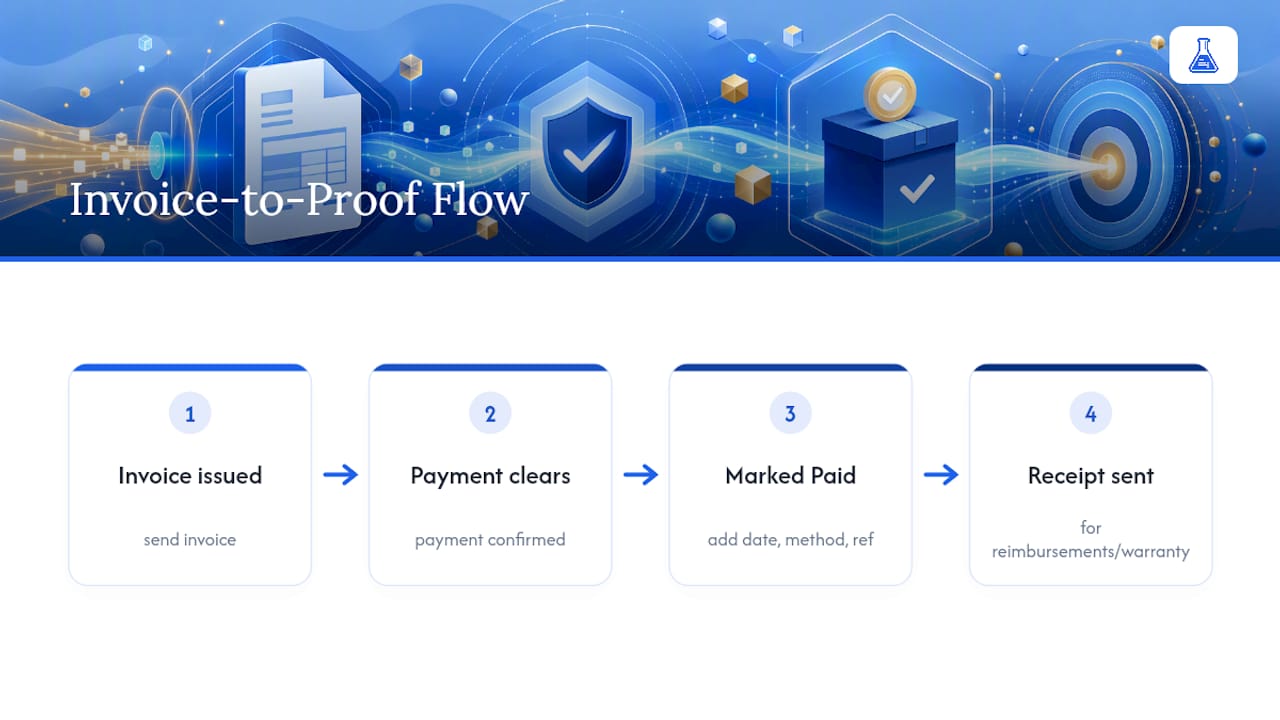
Separate receipts still make sense for reimbursements, warranty claims, or any case where the customer needs a standalone document independent of the original billing paperwork. Payment platforms like Stripe automate this well: once a charge clears, the system marks the invoice paid and fires off a receipt in the same motion, no manual step required.
Legal Implications and Validity of Invoices Versus Receipts
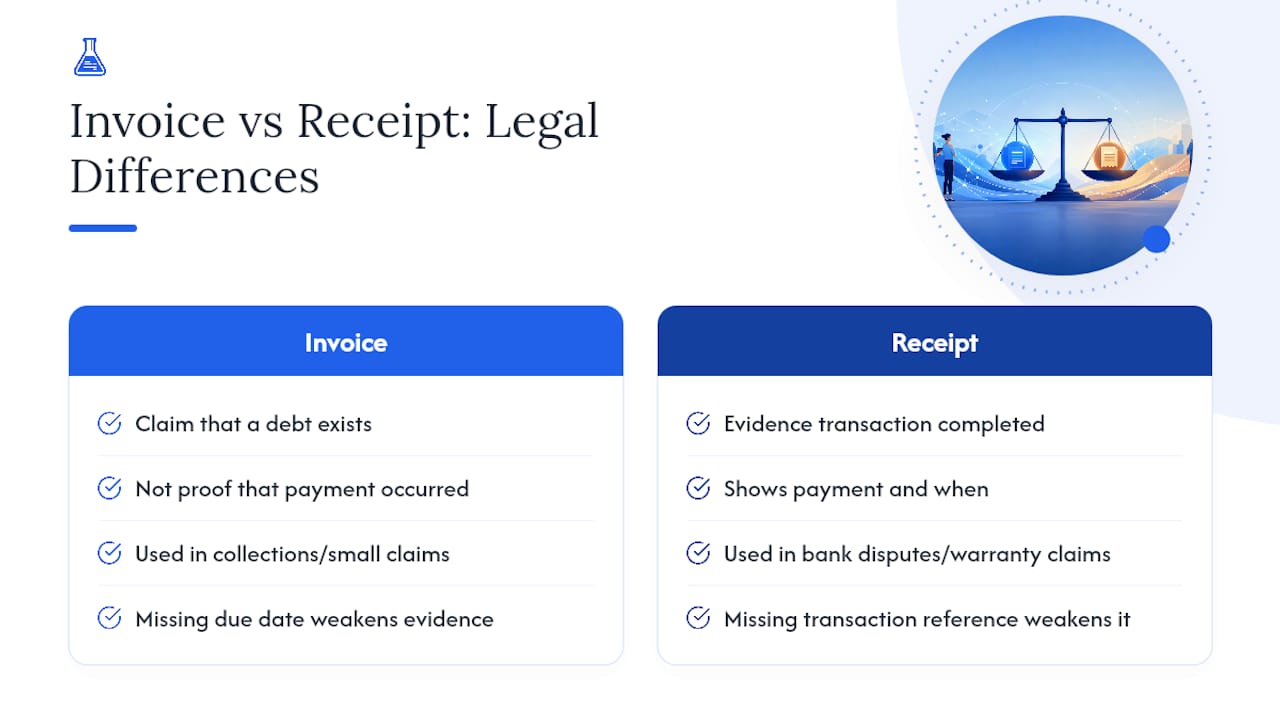
Invoices and receipts carry different legal weight, and confusing the two can create real problems in a dispute. An invoice is a claim, a documented request that a debt exists. It’s evidence of what was agreed, not evidence that money changed hands. Courts and tax authorities generally treat an unpaid invoice as proof of an obligation, useful in a collections case or a small claims filing, but it doesn’t establish that payment occurred.
A receipt is evidence of a completed transaction. If a customer disputes a charge with their bank or files a warranty claim, the receipt is usually the document that matters, because it shows money actually moved and when. This is why keeping both documents, cross-referenced by transaction ID, matters more than either one alone.
There’s also a validity question around completeness. An invoice missing a due date or a receipt missing a transaction reference isn’t automatically void, but it’s weaker evidence if a disagreement escalates. Tax authorities in most jurisdictions expect invoices above a certain value to include specific fields, particularly for VAT-registered transactions, and an incomplete document can delay a VAT reclaim or trigger extra scrutiny during an audit. Retention periods matter too. Most tax authorities expect several years of invoice and receipt records on file, and digital copies are broadly accepted as valid records for bookkeeping and tax purposes as long as they’re complete and stored reliably. Losing a paper receipt is a bigger problem than losing a digital one you can pull up in seconds.
Paper, PDF, and E-Invoicing: How Format Has Changed
Paper invoices and handwritten receipts haven’t disappeared, but they’re increasingly the exception rather than the rule for service businesses and online sellers. Most freelancers and agencies now generate both documents as PDFs, delivered by email or through an invoicing platform, which makes storage, search, and reconciliation dramatically easier than a shoebox of paper slips.
E-invoicing takes this further. Rather than sending a PDF that a human opens and reads, e-invoicing systems exchange structured data directly between the seller’s and buyer’s accounting software, often in a standardized format that gets validated automatically. Several countries have started mandating e-invoicing for business-to-business transactions above certain thresholds, particularly across parts of the European Union, as tax authorities push for real-time visibility into transactions. If you sell internationally, it’s worth checking whether your buyer’s country requires a structured e-invoice format rather than a plain PDF, because a beautifully designed PDF invoice can still get rejected by a government portal that expects machine-readable data.
Receipts have followed a similar path, just with less regulatory pressure. Point-of-sale systems generate digital receipts by default now, often offering a choice between a printed slip and an emailed copy. The format matters less here than completeness. A digital receipt that’s missing the transaction ID or payment method is no more useful than a faded paper one, regardless of how polished it looks.
How Invoices and Receipts Work Across Industries
The core distinction between a payment request and payment proof holds everywhere, but how often each document gets used shifts a lot by business model.
Retail and e-commerce lean almost entirely on receipts. A customer pays at checkout, whether in person or online, and the receipt is generated instantly. Invoices are rare in this world unless a business customer specifically requests one for their own expense tracking, which happens more often in B2B e-commerce than consumer retail.
Freelancers and agencies live and die by invoices. Web developers, graphic designers, and consultants typically bill on completion or at project milestones, and the gap between sending the invoice and receiving payment can stretch for weeks. That gap is exactly where late payment problems creep in, which is why clear due dates and payment terms carry more weight in this world than in retail.
Subscription and SaaS businesses generate invoices automatically on a billing cycle, often paired with instant receipts the moment a card charges successfully. Construction and trades tend to use staged invoicing tied to project milestones, deposit up front, progress payments during the build, final invoice on completion, each stage backed by its own receipt once paid. Tutors and consultants working with individual clients often blend the two worlds, sometimes invoicing formally and sometimes issuing a receipt on the spot for a single session paid in cash or by card.
Fixing Mistakes on Invoices and Receipts
Errors happen: a wrong line item, a missing VAT number, a client’s name misspelled on a formal invoice. The fix depends on whether the document has already been paid.
For an unpaid invoice, the cleanest fix is usually to void it and reissue a corrected version with a new invoice number, keeping a note of which invoice it replaces. Editing an already-sent invoice directly creates confusion if the client kept the original for their own records.
For a paid invoice or a receipt that turns out to be wrong, a credit note is the standard tool. A credit note formally cancels or adjusts the original amount without deleting the transaction history, which matters for both your books and your client’s. If you overcharged a client by $75, you don’t just quietly fix your internal spreadsheet; you issue a credit note for $75 that references the original invoice number, then apply it against the next invoice or refund it directly.
Receipts are trickier to correct after the fact because they’re meant to be immutable snapshots of what happened at a specific moment. If a receipt has an error, the standard practice is to issue a corrected receipt that explicitly supersedes the original, rather than editing the first one, so your records show exactly what changed and when. Never delete or silently overwrite either document. Keeping the error and its correction both on file is what makes a bookkeeping trail defensible during a VAT review.
Invoicing and Receipts Around the World
Requirements diverge more than most small business owners expect once you start selling across borders. VAT-registered businesses in the European Union and the UK generally need to include VAT registration numbers and itemized tax rates on invoices above certain thresholds, and cross-border B2B sales within the EU often require reverse-charge notations that don’t apply domestically.
In the United States, there’s no federal VAT equivalent, so sales tax rules vary by state, and receipts typically need to show the specific sales tax rate applied rather than a VAT breakdown. Several countries in Latin America, along with a growing number in Asia, have moved toward mandatory government-validated e-invoicing, where every invoice gets a digital stamp from a tax authority portal before it’s considered legally valid, a much stricter requirement than the “keep good records” approach common in the UK and US.
If you’re a freelancer or agency invoicing clients internationally, the safest habit is to check the buyer’s country requirements before assuming your standard template works everywhere. A US-based invoice format that’s perfectly fine for a domestic client can be missing fields a VAT-registered EU client needs to reclaim tax on the purchase.
What Actually Reduces Disputes
The businesses that spend the least time chasing payment confusion are the ones that treat invoices and receipts as a paired system, not two separate chores. Every reconciliation headache we’ve seen traced back to one missing half: an invoice with no matching receipt, or a receipt with no invoice number to anchor it. Tools that generate both automatically, tied to the same transaction record, remove that gap almost entirely.
— Black Flame Digital
Get Your Invoicing and Receipts Handled in One Step
Chasing down a missing receipt or rebuilding an invoice from scratch costs you time you could spend on billable work, so check out these cash flow management tips for small business owners to streamline your finances. Create a professional invoice quickly, and once a client pays through Stripe integration, the paid status and payment record can update automatically, removing the need to track a separate receipt.
Real-time tax calculations help ensure your VAT breakdown is correct before sending, and invoices can carry your logo and brand colors rather than a generic template. Whether you bill as a web developer, a tutor, or a consulting agency, the free invoice generator gets you a compliant, branded invoice without an account or a learning curve. Try it on your next client bill and see how much faster reconciliation feels once both documents come from the same source.
Sources
- Is an invoice a receipt? Here’s what to know | Stripe
- Invoice vs receipt: what’s the difference? | Sage UK
- Invoice vs receipt: Understanding the differences - Acrobat
Recommended
Send your next invoice in seconds
Create professional invoices, track payments and get paid faster — free to start.