Avoid VAT Audits: 5-Step Proforma to Invoice Checklist for SMEs
A proforma invoice is a preliminary, non-binding estimate of costs. A standard invoice is the formal accounting document that creates a real payment obligation and, in most jurisdictions, a VAT liability. Confuse the two on your books and you risk misreported tax, broken invoice numbering, and an uncomfortable conversation during an audit.
TL;DR:
- Proforma invoices are estimates and should never be recorded as legally binding invoices or VAT-liable documents.
- Using the same numbering series or displaying VAT on a proforma as if it were a final invoice risks audit rejection and tax reporting errors.
- Proformas are essential for customs clearance, financing, and internal approval, but final invoices are required for actual payment and VAT reporting.
- Mark proforma templates clearly with labels like “NOT A TAX DOCUMENT” and keep their numbering separate from official invoices.
- Convert proformas into final invoices only after confirming delivery details, and ensure all VAT and payment terms are properly finalized and recorded.
Table of Contents
- Proforma Invoice vs Invoice: What Actually Separates Them
- What Is a Proforma Invoice? Definition, Fields, and Legal Status
- What Is a Standard Invoice? Required Fields and Accounting Effect
- Comparing Proforma and Final Invoices Side by Side
- When Should You Use a Proforma Invoice?
- How Proformas Interact With VAT and Where Audits Go Wrong
- Customs and Cross-Border Shipping: Where Accuracy Really Counts
- How to Convert a Proforma Into a Final Invoice
- Best Practices for Templates, Labels, and Recordkeeping
- How InvoiceLabs Fits Into This
- Generate Compliant Invoices and Proformas in Under a Minute
- Sources
- FAQ
Proforma Invoice vs Invoice: What Actually Separates Them
The short answer: one is a quote dressed up as an invoice, and the other is the real thing. A proforma invoice is not legally an invoice at all, even though it looks almost identical. Dictionaries define it as a document stating a seller’s commitment to sell goods at a given price, without functioning as a formal demand for payment. A standard invoice, by contrast, is the document that actually triggers a debt, a due date, and a VAT entry on your books.
That distinction sounds academic until you send a proforma to a client who then pays it, books it as a tax invoice, and later gets flagged in a VAT inspection. It happens more often than you’d think, mostly because the two documents share nearly every visual element: logo, line items, totals, client details. The label is often the only thing telling them apart.
What Is a Proforma Invoice? Definition, Fields, and Legal Status
A proforma invoice is a preliminary bill of sale you send before goods ship or work is delivered. It sets expectations on price, scope, and terms, without being a demand for payment. Businesses typically send one when a buyer needs cost confirmation before releasing a purchase order, arranging financing, or applying for an import license.
Because a proforma has no fixed legal format, you have latitude in how you build it. That flexibility is also why labeling matters so much: nothing stops it from looking exactly like a tax invoice unless you make the distinction obvious. Most proformas include:
- A description of goods or services and estimated quantities
- Estimated unit and total prices, often marked as subject to change
- Estimated shipping, handling, or freight costs
- A validity period (commonly 15 to 30 days)
- Incoterms, when the deal involves cross-border shipment
- A clear label such as “PROFORMA INVOICE” and a note that it’s not a tax document
Sage’s accounting guidance notes that proformas are not legally binding and can be canceled or revised freely before the final invoice goes out. That’s the whole point of the document: it lets both sides agree on numbers before anything becomes official.
What Is a Standard Invoice? Required Fields and Accounting Effect
A standard invoice, sometimes called a commercial or tax invoice, is issued once goods are delivered or a service is complete. It is the trigger point: the moment a seller formally requests payment and the moment your accounting system needs to recognize revenue and, where applicable, VAT.
Unlike a proforma, a tax invoice does have mandatory content in most jurisdictions, because tax authorities and buyers both rely on it for recordkeeping. A compliant invoice generally needs:
- Supplier’s legal name, address, and VAT or tax registration number
- A sequential, unique invoice number (no gaps, no duplicates)
- Issue date and payment due date
- An itemized breakdown of goods or services actually delivered
- VAT rate and amount, broken out separately from the net total
- Total amount due and accepted payment methods
The moment you issue this document, it becomes part of your VAT return and your accounting ledger. If you’re building this out for the first time, a purchase invoice guide walks through how these entries flow into bookkeeping on the buyer’s side too. Every invoice number in that sequence has to reconcile, which is exactly where a mislabeled proforma can quietly cause problems months later.
Comparing Proforma and Final Invoices Side by Side
Put the two documents next to each other and the differences stop being abstract. Here’s how they actually behave across the axes that matter to a finance team:
| Axis | Proforma invoice | Standard (final) invoice |
|---|---|---|
| Legal status | Non-binding estimate | Legally binding demand for payment |
| When issued | Before supply or delivery | At or after supply/delivery |
| Accounting/VAT effect | No VAT liability, no journal entry | Creates VAT liability and revenue entry |
| Numbering | Separate series, often prefixed | Sequential, gap-free invoice number |
| Typical fields | Estimated prices, validity period | Fixed prices, VAT breakdown, due date |
| Use cases | Order confirmation, customs, financing | Payment collection, VAT recovery, audit trail |
A few scenarios show why this matters in practice:
- A manufacturer shipping machinery abroad sends a proforma so the buyer’s bank can open a letter of credit, then issues the real invoice once the goods clear customs.
- A consultant quoting a three-month retainer sends a proforma to get sign-off from the client’s finance department, then bills weekly with standard invoices tied to actual hours worked.
- A retailer taking a large custom order sends a proforma to confirm pricing before production starts, and only invoices formally once the order ships.
In each case, the proforma buys time and clarity. The standard invoice is what actually shows up in the books. Confusing the order, invoicing formally before terms are locked in, or treating a proforma as the final bill, is where most of the headaches in this comparison start.
When Should You Use a Proforma Invoice?
Not every quote needs a proforma, but certain situations call for one specifically because a rough number on an email thread isn’t enough documentation.
- Order confirmation before production or shipment. Send a proforma when a buyer needs written cost confirmation to approve a purchase order internally.
- Customs clearance for non-sale shipments. Samples, gifts, and returns often need a proforma so customs can assess value without a completed sale.
- Financing or import licensing. Buyers sometimes need a proforma to secure a loan, letter of credit, or import permit before the transaction is finalized.
- Internal budget approval. Large B2B buyers frequently require a proforma so their procurement team can allocate funds before the deal closes.
A final invoice becomes necessary the moment any of the following applies: you need to recover input VAT, you’re formally demanding payment with a due date, or your jurisdiction requires an advance VAT invoice on a deposit. If your business collects deposits regularly, it’s worth reading how a prepayment invoice differs from a proforma. Deposits often carry their own VAT timing rules that proformas simply don’t trigger.
The decision rule finance teams should default to: if money is changing hands or VAT needs to be reported, it’s a final invoice. If you’re confirming numbers before anything is locked in, it’s a proforma.
How Proformas Interact With VAT and Where Audits Go Wrong
A proforma invoice creates no VAT liability and should never generate a journal entry in your accounting system. That’s not a matter of preference. HMRC guidance is explicit that recording a proforma as though it were a VAT invoice is a common and avoidable mistake.
The risk compounds when a proforma mimics a real invoice too closely. If it shares the same numbering series as your tax invoices, or shows a VAT figure that looks like it’s been charged rather than estimated, an auditor may reasonably treat it as a tax invoice. That can break your invoice sequence, since tax authorities expect no gaps and no duplicates in that run of numbers, and it can lead a buyer to mistakenly claim input VAT on a document that never should have counted toward their tax return, a mistake flagged in industry commentary on proforma versus invoice practices.
Three safeguards prevent most of this:
- Label every proforma clearly, ideally with wording like “PROFORMA INVOICE — NOT A TAX DOCUMENT.”
- Use a completely separate numbering series for proformas so they never intersect with your invoice sequence.
- Avoid presenting VAT as a charged amount on a proforma. If you show tax at all, mark it as estimated.
Pro Tip: Add one explanatory line at the bottom of every proforma stating whether VAT is included or estimated. It takes ten seconds and eliminates most of the confusion that leads to audit questions later.
Customs and Cross-Border Shipping: Where Accuracy Really Counts
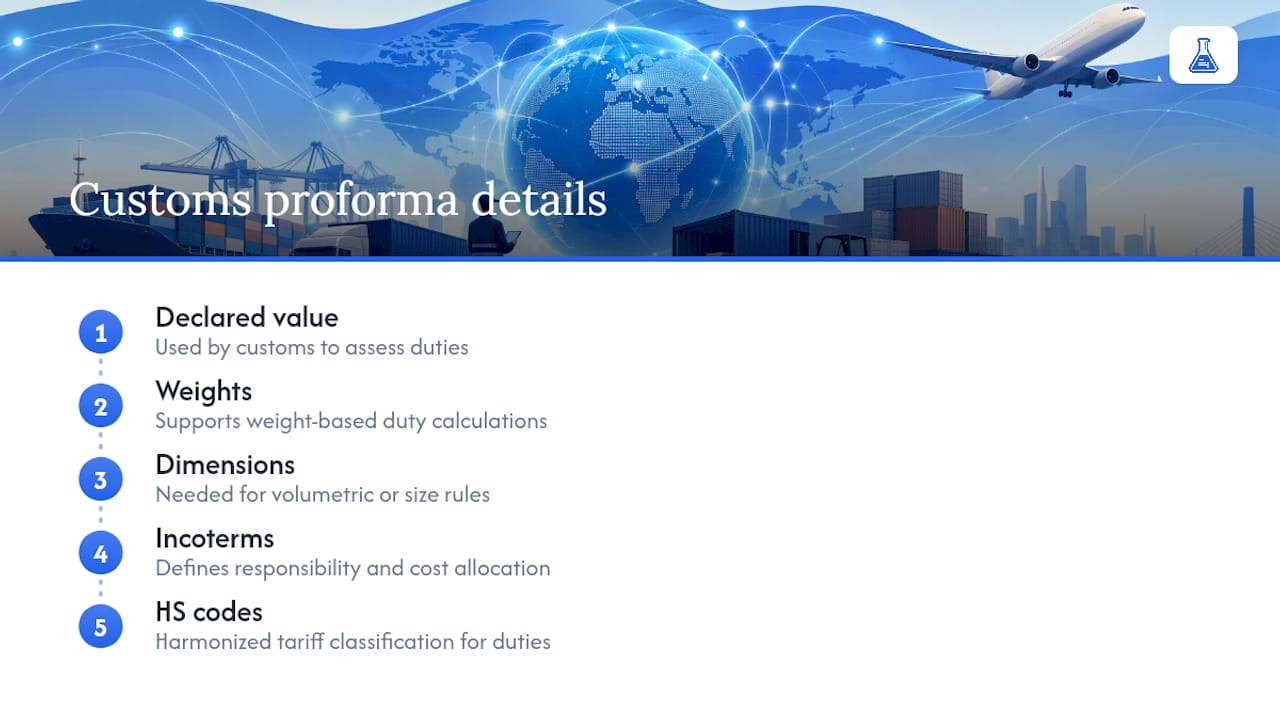
Proformas do heavy lifting in international trade. Customs authorities frequently use them to assess duties before a shipment moves, especially when a commercial invoice isn’t yet appropriate for the transaction, as outlined in Trade for exporters. There’s no universal legal format for these documents, but customs officers expect enough detail to calculate duties correctly the first time.
That means including declared value, weights and dimensions, Incoterms, and harmonized system (HS) codes where you have them. Get sloppy here and clearance delays follow, because changes submitted after the fact often mean re-filing paperwork rather than a quick correction. Businesses managing regular international shipments sometimes lean on specialized cross-border compliance support to keep proforma details consistent with what customs actually requires. A commercial invoice becomes mandatory instead of a proforma once the goods have a confirmed sale value and buyer, not an estimated one.
How to Convert a Proforma Into a Final Invoice
Once the deal is confirmed, converting is mostly a matter of locking down what was previously an estimate.
- Confirm final deliverables, quantities, and shipping details against what was actually supplied.
- Assign a sequential invoice number from your standard invoice series, not the proforma series.
- Add your VAT registration number and calculate actual VAT owed, if applicable.
- Set firm payment terms and a due date, referencing your standard payment terms if you use consistent net-30 or net-15 windows.
- Record the transaction in your accounting system and send the buyer a copy for their records.
If the deal changes after you’ve already issued a final invoice, don’t just re-issue it. Issue a credit note against the original and then a corrected invoice, so your numbering stays clean.
Best Practices for Templates, Labels, and Recordkeeping
Most proforma mistakes trace back to sloppy templates, not bad intentions. A few habits fix that at the source:
- Build your proforma template with the words “PROFORMA INVOICE — NOT A TAX DOCUMENT” printed clearly at the top, plus one line explaining that figures are estimates.
- Use a distinct numbering prefix, such as “PRO-,” so proformas never overlap with your invoice sequence.
- Set an internal rule that no proforma converts to a final invoice without someone checking quantities, pricing, and VAT status first.
- Keep proformas and final invoices in separate folders or tags in your accounting software so recordkeeping stays clean at tax time.
A billing system that handles both document types with distinct templates makes this almost automatic. Our own guide to invoicing best practices for freelancers and small businesses covers the broader recordkeeping habits worth building alongside this.
Pro Tip: If you ever find yourself unsure whether a document should be a proforma or a final invoice, ask one question: has the supply actually happened yet? If yes, it’s a final invoice. No exceptions.
How InvoiceLabs Fits Into This
The pitfalls above almost always come down to templates that don’t clearly separate estimate from obligation. The platform builds that separation in from the start, with features like real-time tax calculations, clear document labeling, and instant PDF delivery to avoid confusion over numbering series. Tracking status on every invoice also means you catch a stalled proforma before it accidentally becomes an overdue payment problem.
— Black Flame Digital
Generate Compliant Invoices and Proformas in Under a Minute
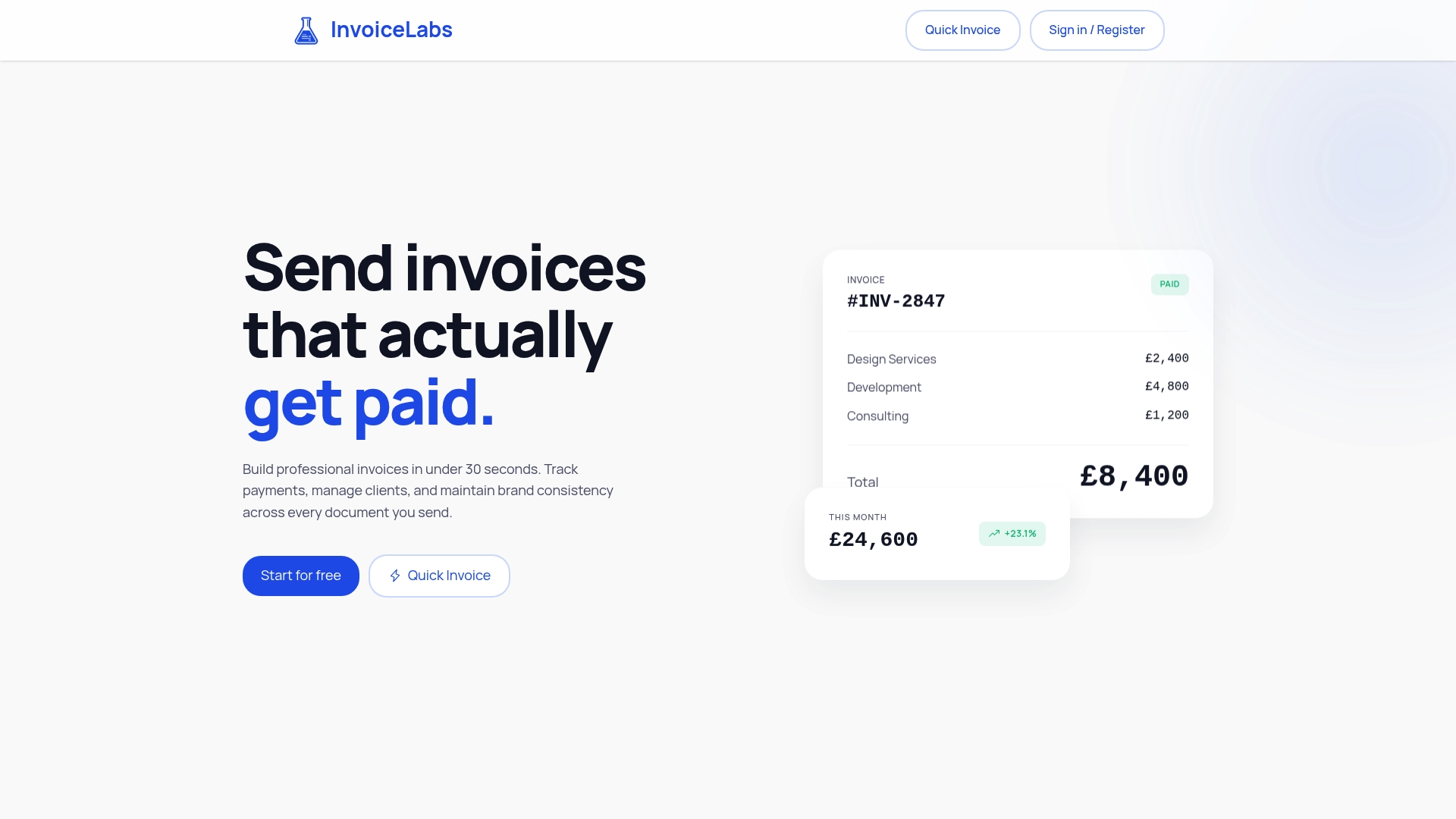
Building a proforma and final invoice from scratch every time invites the exact labeling mistakes covered above. InvoiceLabs solves that with a free invoice generator that creates clearly labeled, professional documents in under 30 seconds, with real-time tax calculations built in so your VAT figures are correct before you hit send.
If you bill by profession, a template tailored to your work saves even more setup time. Consultants can start from a consultant invoice template, and web developers have their own ready-made invoice template built around common project billing structures. Once you’re ready to collect payment, integrations with payment processors like Stripe let clients pay directly from the invoice, and status tracking can show when invoices have been viewed or paid. Try the free generator on your next quote and see how much friction that labeling clarity removes.
Sources
- Pro Forma Invoice
- Cambridge Dictionary — pro‑forma invoice
- HMRC internal manual — VAT invoice guidance (VATREC9010)
FAQ
Can a Proforma Invoice Be Paid?
Technically yes, a buyer can send payment against a proforma, but doing so is risky because the document isn’t a formal demand for payment and typically hasn’t locked in final VAT or pricing details. If payment happens, issue a proper final invoice immediately to correct the accounting record.
Can a Proforma Invoice Be Used as an Invoice?
No. A proforma invoice is not a tax invoice and should never be recorded as one in your accounting or VAT records, a mistake HMRC specifically warns against.
Is a Proforma Invoice the Final Invoice?
No, a proforma is a preliminary estimate sent before the sale is finalized, while the final invoice is issued once goods or services are actually delivered and creates the real payment and VAT obligation.
Why Do Companies Issue Proforma Invoices?
Companies issue proformas to confirm pricing and terms before a sale closes, to support customs clearance on shipments that aren’t a finalized sale, or to help a buyer secure financing or import approval ahead of the actual transaction.
Recommended
Send your next invoice in seconds
Create professional invoices, track payments and get paid faster — free to start.