Invoice for Services Rendered: A Freelancer's 2026 Guide
Invoice for Services Rendered: A Freelancer’s 2026 Guide
A for services rendered invoice is a formal billing document issued after work is complete, converting a service obligation into a legal debt the client must pay. The industry term is a “service invoice,” and both phrases describe the same instrument. Unlike a quote or estimate, this document triggers accounts receivable on your books and a payment obligation on your client’s. For U.S. freelancers in 2026, each invoice also triggers self-employment tax liability of 15.3%, making accurate, timely invoicing a financial planning tool, not just an administrative task.
What are the essential elements of a for services rendered invoice?
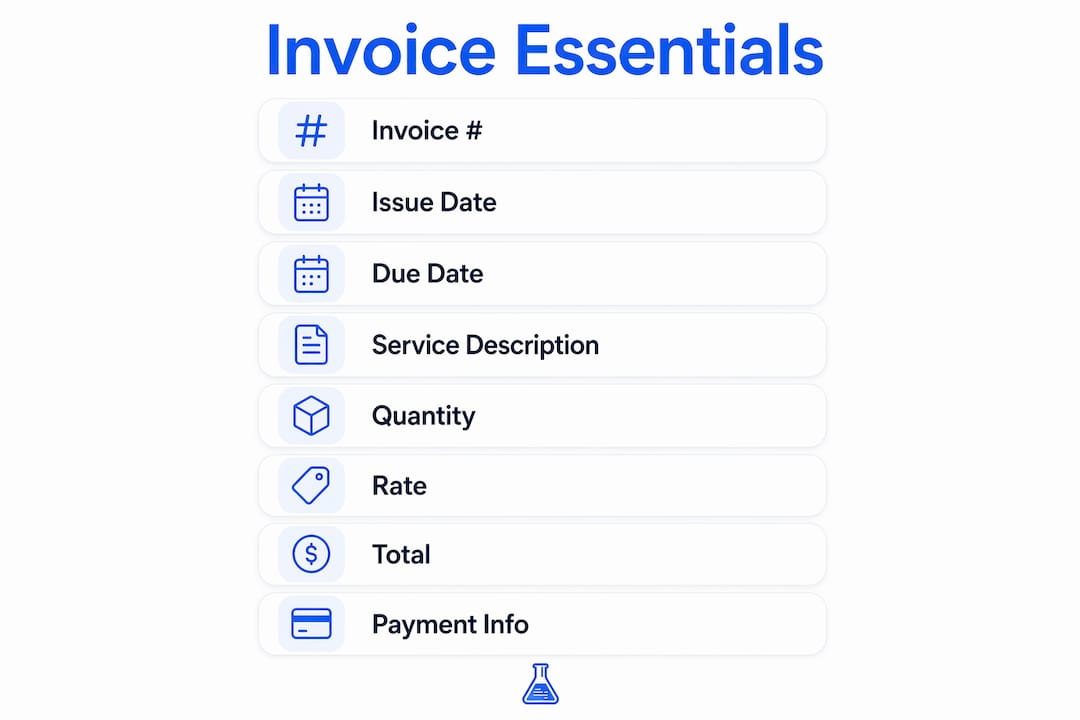
A professional service invoice requires 8 core elements to avoid payment delays: a unique invoice number, issue date, due date, detailed service descriptions, service dates, subtotal, taxes, total due, and precise payment instructions. Miss even one of these, and you risk stalling in a client’s accounts payable queue.
The 8 required fields
- Unique invoice number. Sequential numbering (INV-001, INV-002) lets both parties track documents and prevents duplicate payments.
- Issue date. The date you send the invoice. This starts the payment clock.
- Due date. A specific calendar date, such as “Payment due by June 15, 2026.” Never write “Due on Receipt” alone.
- Detailed service descriptions. Each line item must name the service, the dates performed, the quantity or hours, and the rate.
- Service dates. The actual dates you performed the work, separate from the invoice date.
- Subtotal, taxes, and total due. Break these out on separate lines so the client’s finance team can verify the math instantly.
- Payment instructions. Include your bank details, payment link, or accepted methods. Ambiguity here is the single most common reason payments stall.
- Your contact information and the client’s. Full legal names, addresses, and email addresses for both parties.
Two optional fields that pay for themselves: a Purchase Order (PO) number and a late-fee clause. Invoices lacking PO numbers often stall in accounts payable, doubling payment times. Adding the client’s PO number, even when they did not explicitly request it, removes a common reason for manual review.
| Element | Why it matters |
|---|---|
| Unique invoice number | Prevents duplicates and simplifies record-keeping |
| Explicit calendar due date | Creates a clear breach point for late-payment enforcement |
| Itemized service descriptions | Reduces disputes and speeds finance-team approval |
| PO or project reference | Cuts manual review and speeds payment processing |
| Payment instructions | Eliminates back-and-forth that delays collection |

Pro Tip: List your payment link or bank transfer details in bold at the bottom of every invoice. Clients who can pay in one click pay faster than those who have to search for your account number.
How do you write clear service descriptions on an invoice?
Vague descriptions cause disputes and slow payment. Clear, detailed service descriptions reduce both, because the invoice functions as a formal business instrument, not a friendly note. Finance teams and automated payment systems read your invoice first. Clarity for those audiences is what gets you paid on time.
A weak description looks like this: “Consulting services — $1,500.” A strong one reads: “Brand strategy consulting, March 3–7, 2026, 10 hours at $150/hr — $1,500.” The second version answers every question a finance manager or automated system will ask before approving payment.
Best practices for service line items
- Name the specific service, not a category. Write “Website copywriting” not “Writing services.”
- Include the date range the work covered.
- State the quantity and unit. “8 hours” or “3 deliverables” is clearer than “project work.”
- Add a one-line description of the output. “Homepage and About page copy, final draft delivered March 10, 2026.”
- List each service as a separate line item. Bundling unrelated tasks into one line invites questions.
- Round rates to clean numbers where possible. “$125/hr” is easier to verify than “$123.75/hr.”
Invoices read by finance teams and automated systems require clarity for faster approvals. A description that passes a human reviewer’s eye also passes an automated matching system, which many mid-size and large companies now use to process vendor payments.
Pro Tip: Reference your contract or statement of work in the invoice description. A note like “Per SOW dated February 1, 2026” gives the client’s team an instant paper trail and removes the most common reason for payment holds.
What billing models work best for service invoices?
The billing model you choose shapes how you structure every line item on your service payment invoice. Five models cover most service businesses: hourly rate, fixed project fee, retainer, milestone-based, and day rate.
Hourly rate works best when scope is uncertain or the client wants flexibility. You log hours, multiply by your rate, and invoice at agreed intervals. The downside is that clients sometimes question hour counts, so detailed time logs are non-negotiable.
Fixed project fee suits well-defined deliverables. A graphic designer charging $2,000 for a logo package knows the scope; the client knows the total cost. Disputes arise only when scope creeps, so a clear contract is the fix.
Retainer billing fits ongoing relationships. A consultant on a $3,000/month retainer invoices the same amount each month regardless of hours. This model rewards efficiency and gives both parties predictable cash flow.
Milestone-based billing ties payment to project phases. A web developer might invoice 30% on kickoff, 40% on design approval, and 30% on launch. This model protects both parties: the client pays only for completed work, and you collect before the project ends.
Day rate is common in consulting, film production, and event work. It is simpler than hourly billing and signals a professional market rate.
| Billing model | Best for | Key consideration |
|---|---|---|
| Hourly rate | Variable or open-ended projects | Requires detailed time logs |
| Fixed project fee | Defined deliverables | Needs a tight scope of work |
| Retainer | Ongoing relationships | Set clear deliverable expectations |
| Milestone-based | Long or phased projects | Define milestones in the contract |
| Day rate | Short engagements, consulting | Agree on what constitutes a full day |
Freelancers and small business owners often default to hourly billing because it feels safe. Fixed-fee and retainer models, however, typically generate higher effective hourly rates once you factor in the time saved on tracking and reporting.
What payment terms reduce late payments most effectively?
Payment terms are the single most controllable variable in your cash flow. Using explicit calendar due dates instead of vague terms like “Due on Receipt” establishes a clear breach point and speeds collection. “Due on Receipt” is legally ambiguous. “Payment due by June 30, 2026” is not.
The most common terms in service invoicing are Net 15, Net 30, and Due on Receipt. Net 15 means payment is due 15 days after the invoice date. Net 30 gives the client 30 days. Shorter terms improve your cash flow but may not suit all client relationships.
Two tools that measurably improve collection rates: late-payment penalties and early-payment discounts. A 1.5% monthly interest charge on overdue balances, combined with a 2% discount for payment within 7 days, gives clients a financial reason to pay early and a financial cost for paying late. Both terms must appear on the invoice itself to be enforceable.
Steps to set payment terms that work
- Agree on terms before the project starts. Include them in your contract.
- Restate the same terms on every invoice. Consistency removes confusion.
- Write the due date as a specific calendar date, not a relative term.
- Add your late-fee policy in a short line below the total. “Invoices unpaid after [date] accrue 1.5% monthly interest.”
- Send the invoice immediately after completing the work or hitting a milestone. Invoicing immediately after completion yields faster payments than delayed invoicing.
Pro Tip: Put the due date in a larger font or bold text near the total amount. Finance teams scan invoices quickly. A due date that stands out gets noticed before one buried in the footer.
Key takeaways
A service invoice is a legal document that creates a payment obligation the moment you send it, so every field you fill in either speeds or slows your collection.
| Point | Details |
|---|---|
| Use all 8 required fields | Missing any core element, especially a due date or payment instructions, delays payment. |
| Write specific service descriptions | Name the service, dates, quantity, and rate on every line item to prevent disputes. |
| Match billing model to project type | Fixed-fee and retainer models often yield higher effective rates than hourly billing. |
| Set explicit calendar due dates | A specific date like “June 30, 2026” is enforceable; “Due on Receipt” is not. |
| Invoice immediately after completion | Sending the invoice right after delivery is the simplest way to get paid faster. |
Why most freelancers get paid late (and how to fix it)
After years of working with freelancers and small business owners on billing practices, the pattern is clear: most late payments trace back to the invoice itself, not the client. Freelancers treat invoices as polite requests. Clients treat vague invoices as optional. The fix is a mindset shift.
An invoice for services is a legal statement. It initiates a payment obligation the moment the client receives it. When you write “services rendered” with no dates, no rates, and no due date, you are handing the client’s finance team a reason to put your document in a review pile. Specificity is not pedantic. It is the difference between a 14-day payment and a 60-day payment.
The other mistake I see constantly: freelancers send invoices days or weeks after completing work. That gap signals to the client that payment is not urgent. Send the invoice the same day you deliver the work or hit the milestone. Pair that habit with a billing and invoicing guide that covers your full payment cycle, and late payments become the exception rather than the rule.
Automation removes the human error that causes most invoicing problems. When your invoice tool auto-numbers documents, calculates tax in real time, and sends payment links instantly, you eliminate the gaps that slow collection. The freelancers I have seen get paid fastest are not the ones with the best clients. They are the ones with the most consistent invoicing process.
— Black Flame Digital
Professional invoicing made simple with Invoicelabs
Invoicelabs builds invoicing tools specifically for freelancers and small business owners who need to send professional documents fast.
The free invoice generator creates a complete, professionally formatted invoice in under 30 seconds. It handles unique invoice numbering, real-time tax calculations, and instant delivery, so you spend your time on client work, not paperwork. Invoicelabs also offers profession-specific templates, including options for graphic designers and consultants, each pre-formatted with the fields your clients expect. Payment collection runs through Stripe, so clients can pay the moment they open the invoice. Bank-grade security and no hidden fees are standard on every plan.
FAQ
What is a for services rendered invoice?
A for services rendered invoice is a formal billing document issued after work is complete, requesting payment for services already delivered. It converts a service obligation into a legal debt and triggers accounts receivable on the provider’s books.
What should I include in a service invoice?
A service invoice must include a unique invoice number, issue date, explicit due date, itemized service descriptions with dates and rates, subtotal, taxes, total due, and payment instructions. Missing any of these fields can delay payment.
How do I write service descriptions that prevent disputes?
Name the specific service, include the date range performed, state the quantity and rate, and add a one-line description of the deliverable. Referencing the contract or statement of work in the description removes the most common reason clients place invoices on hold.
What payment terms work best for freelancers?
Net 15 or Net 30 with a specific calendar due date works best for most freelancers. Adding a 1.5% monthly late-payment penalty and a 2% early-payment discount gives clients a financial incentive to pay on time.
When should I send an invoice for services rendered?
Send the invoice the same day you complete the work or reach a project milestone. Invoicing immediately after delivery consistently produces faster payments than waiting days or weeks after completion.
Recommended
Send your next invoice in seconds
Create professional invoices, track payments and get paid faster — free to start.