How to Add Expenses to an Invoice in the UK
How to Add Expenses to an Invoice in the UK

To add expenses to an invoice, list each one on its own line beneath your fee, decide whether it is a recharge or a disbursement, and charge VAT accordingly. Get that one decision right and the rest is layout. A recharge is a cost your business incurred itself, so it carries VAT. A disbursement is a payment made on your customer’s behalf, so it sits outside VAT. Getting the invoice out fast matters too, because unpaid expenses are money you are already out of pocket for. On InvoiceLabs you can build the invoice in under 30 seconds, with tax and discounts calculated in real time as you add lines.
TL;DR
- Show every expense as its own line, separate from your fee, with a short description and the amount.
- Recharges (your own travel, postage, bank transfer fees) are part of your supply, so VAT applies at the rate of your main service, even if the underlying cost had no VAT.
- Disbursements (something bought for the client, in their name, passed on at exact cost) carry no VAT, but only if every HMRC condition is met.
- Keep the receipt or supplier invoice for each item. Without it you cannot prove a disbursement or reclaim VAT.
- Send the invoice promptly and track its status so expenses are paid back quickly.
Table of Contents
- The decision that shapes the invoice: recharge or disbursement
- A worked example with the numbers
- How to add expenses to an invoice, step by step
- Should you add a markup?
- When expenses affect your VAT threshold
- Records to keep
- Avoiding the errors that delay payment
- Where InvoiceLabs fits
- Our perspective
- FAQ
- Sources
The decision that shapes the invoice: recharge or disbursement
Most confusion about expenses on invoices comes down to one question: whose cost was it?
According to HMRC’s guidance on costs passed to customers, incidental costs you incur yourself while supplying your service are recharges. Examples HMRC gives include travelling expenses, your own postage and delivery costs, airline tickets you buy to visit a client, and bank transfer fees. You must charge VAT on a recharge whether or not you paid VAT on the original cost.
A disbursement is different. It is a payment you make to a supplier on your customer’s behalf. HMRC lets you pass it on without VAT only when all of these are true:
- the customer received, used or benefited from the goods or services;
- it was the customer’s responsibility to pay;
- the customer gave you permission to pay on their behalf;
- the customer knew the supplier was a third party;
- you show the cost separately on your invoice;
- you pass on the exact amount you paid;
- the goods or services are in addition to your own services.
If you cannot tick every box, treat the cost as a recharge. ACCA’s technical article on VAT on disbursements and recharges restates the same conditions and stresses that they all have to be met.
Quick sorting guide
| Expense | Usually treated as | VAT on your invoice |
|---|---|---|
| Train or flight to visit the client | Recharge | Yes, at the rate of your main supply |
| Your own postage and courier costs | Recharge | Yes |
| Bank transfer fee (for example a CHAPS fee) | Recharge | Yes |
| Website hosting bought in the client’s name and used by them | Disbursement, if all conditions are met | No |
| Court, land registry or probate fees paid for a client | Disbursement, as HMRC’s manual treats them for solicitors | No |
The last two rows depend on the facts. The test is the list above, not the label you give the cost.
Why travel is a recharge even when the ticket has no VAT
This catches people out. A rail ticket is zero-rated, so it is natural to think the recharge is VAT-free too. It is not. ACCA explains that a recharged cost takes the VAT liability of your main supply. If you charge 20% VAT on your service, you charge 20% on the travel you bill alongside it.
HMRC’s internal manual VTAXPER46000 shows how seriously this is taken. It cites a High Court case where a solicitor’s travel costs, recovered from the client at cost, could not be treated as a disbursement because the travel was supplied to the solicitor and formed part of the legal service. It also cites a tribunal decision where a £25 CHAPS fee, recharged as a disbursement, was held to be part of the solicitor’s own taxable supply.
The lesson for a freelancer or consultant is simple: if you bought it to do your job, it is a recharge.
A worked example with the numbers
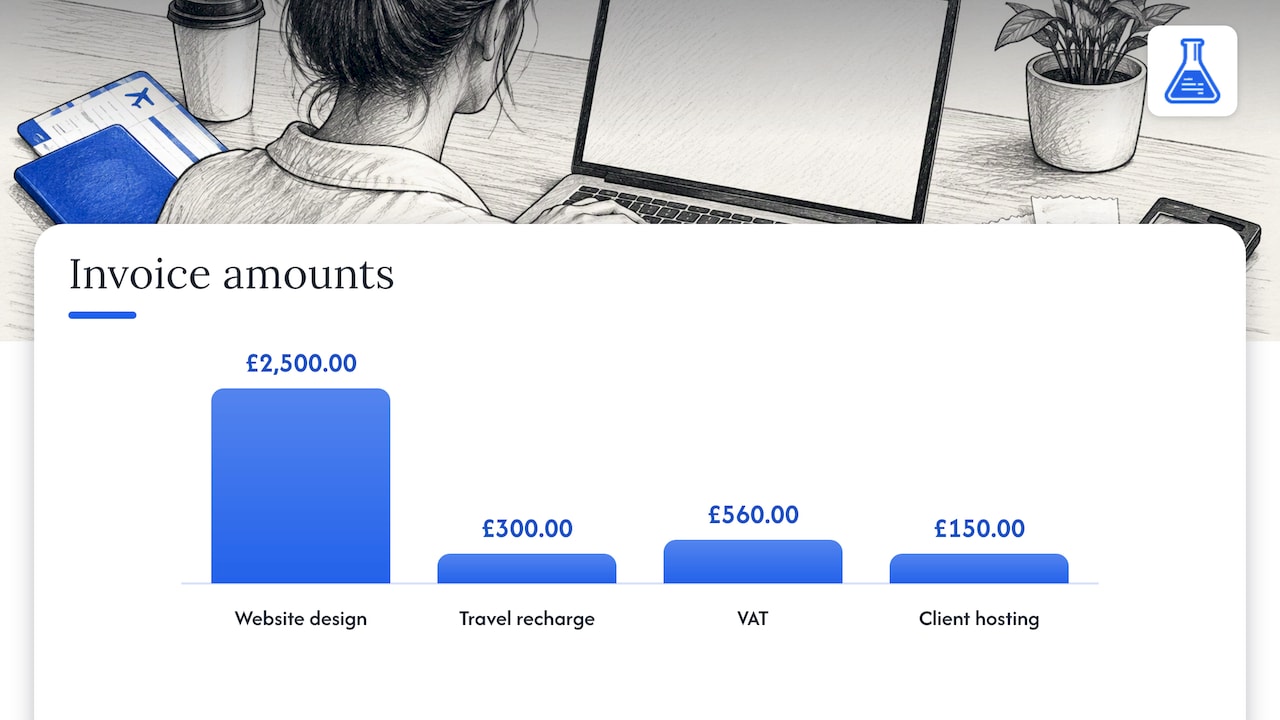
HMRC’s own example is a website design consultant. We have set it out as it would appear on an invoice:
| Line | Type | Amount |
|---|---|---|
| Website design services | Fee | £2,500.00 |
| Travel to client meetings | Recharge | £300.00 |
| Subtotal subject to VAT | £2,800.00 | |
| VAT at 20% | £560.00 | |
| Website hosting package bought for the client | Disbursement, outside VAT | £150.00 |
| Total due | £3,510.00 |
The £560 VAT is 20% of £2,800, covering the fee and the travel recharge. The £150 hosting is shown separately and passed on at exact cost, with no VAT added. The sum of £2,800, £560 and £150 gives the £3,510 total. This follows HMRC’s worked example.
Notice what makes the disbursement work: it is on its own line, it is the exact amount, and the hosting was for the client. Add a margin to it and it is no longer an exact pass-through.
How to add expenses to an invoice, step by step
1. Collect the evidence before you bill
Gather the receipt or supplier invoice for every cost you plan to pass on. HMRC says that if you pass on disbursements without VAT you need evidence, such as order forms and invoices, showing you were entitled to leave them out of the VAT calculation, and that you have not reclaimed the VAT on them. For recharges, you need a valid VAT invoice or receipt to reclaim the VAT you paid on the underlying cost.
Where it goes wrong: a card statement line is not a receipt. Photograph paper receipts as you go, and save emailed ones into a folder named for the client.
2. Classify each cost
Run each item through the disbursement conditions above. If one fails, it is a recharge. Do this before you open the invoice, because the classification decides where the line sits and whether VAT is added.
3. Put the fee first, then each expense on its own line
Give every expense a description a client’s accounts team will recognise: “Return train, London to Leeds, 14 March” beats “Travel”. One line per item makes queries rare and makes it easy for the client to approve payment. If you work across several clients, build it once as a template. InvoiceLabs has profession-based templates, and your logo and colours carry through to every invoice, so expenses appear on a document that looks like yours.
4. Apply VAT line by line
Recharges take VAT at the rate of your main supply. Disbursements take none. If an expense already included VAT when you paid it, you bill what you paid and do not add VAT on top of VAT. Because InvoiceLabs calculates tax and discounts in real time, you see the VAT total change as you enter each line, which makes a wrong rate obvious before you send.
5. Check the invoice carries the required details
A VAT invoice must show the customer’s name and address, the date of supply, the invoice date, the amounts charged, the VAT amount and the total owed, per HMRC’s invoice guidance. Our guide to the 12 mandatory fields on a UK VAT invoice lists them all, and where the VAT number goes is covered separately.
6. Send it straight away and watch the status
Expenses are the part of an invoice you have already paid for. Every week of delay is a week of your own cash tied up. InvoiceLabs delivers invoices instantly and shows their status, so you know whether the client has received it. You can also add card payment through Stripe, charged at 1% per card payment on invoices, so a client can settle the whole amount, expenses included, in one go.
Should you add a markup?
A markup is a commercial choice and belongs in your terms of engagement, agreed before the work starts. The VAT consequence is what matters. HMRC’s disbursement conditions require you to pass on the exact amount, so a disbursement with a margin on it no longer qualifies. If you want to earn a handling fee, show it as a separate line within your own supply, with VAT, and leave the pass-through cost at exact cost.
When expenses affect your VAT threshold
The distinction has a practical edge for small businesses. ACCA notes that recharges are part of what you charge your customer and disbursements are outside the scope of VAT, so misclassifying can matter most when a business trades close to the VAT registration threshold: an incorrect classification could push you over it sooner than you expected. If your turnover is near the threshold, classify carefully and keep the paperwork that shows why each item was treated as it was.
In construction and similar contracts, costs paid on a client’s behalf often come as allowances in the contract. Here is a useful read on how prime cost sums work in UK building contracts. Whatever the sector, the VAT question is the same one: was it your cost or the customer’s?
Records to keep
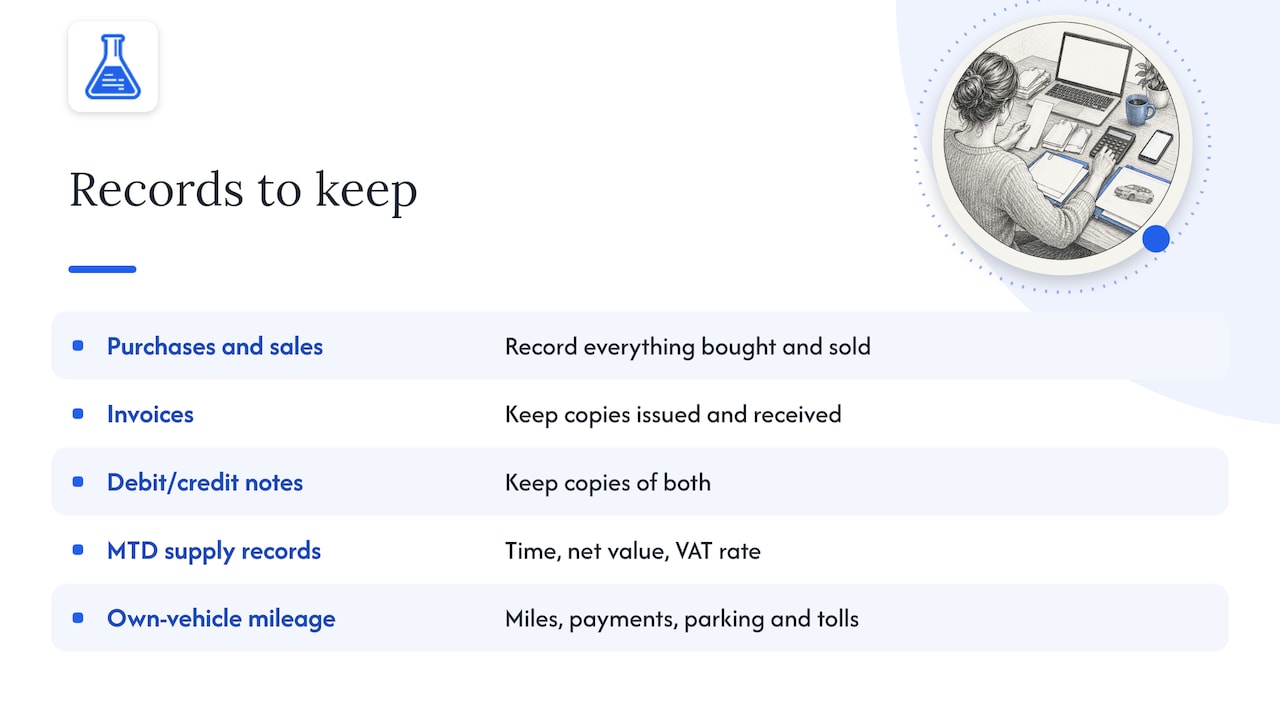
HMRC’s page on keeping VAT records says you must keep a record of everything you buy and sell, copies of all invoices you issue and all invoices you receive, and any debit or credit notes. VAT Notice 700 adds that you need valid evidence of a taxable supply to reclaim input tax, and that a VAT-registered customer needs your VAT invoice to reclaim the VAT you charged them.
If you are VAT-registered, VAT Notice 700/22 on Making Tax Digital requires an electronic account kept in compatible software, recording for each supply the time of supply, the net value and the VAT rate. Extra records such as invoices need not be digital, but they may be.
For mileage in your own vehicle, HMRC’s record-keeping guide says to keep a record of the business miles travelled, what you have been paid, and extra costs such as parking or tolls.
Avoiding the errors that delay payment
Most expense disputes come from a handful of avoidable causes:
- Surprise charges. Mention in your quote or contract that expenses will be billed, and roughly what they will be.
- Vague descriptions. Date, place and purpose on every line.
- Wrong VAT treatment. Run the disbursement checklist, and when in doubt treat it as a recharge.
- Missing receipts. Attach or keep them so you can answer a query in minutes.
- Late billing. Add expenses to the next invoice, or send them the same week.
- Foreign costs. If an expense was in another currency, show the converted amount you actually paid. Our guide to international invoicing from the UK covers VAT and currency, and InvoiceLabs supports multiple currencies.
Where InvoiceLabs fits
If you are building expense invoices in a spreadsheet or word processor, you retype VAT sums every time and the branding drifts. With InvoiceLabs you can start from the free invoice generator without creating an account, add your fee and expense lines, and download a PDF.
For regular billing, the plans are published as Free at £0 per month, Starter at £9 per month, Professional at £19 per month and Business at £49 per month. Paid plans unlock additional clients, companies and unlimited invoices. You can compare them on the InvoiceLabs plans page.
Freelancers, consultants and agencies who bill expenses every month usually want a fast routine more than anything: open, add lines, check the total, send. That is the workflow InvoiceLabs is designed around.
Our perspective
Expenses are where invoices get slow. The fee is agreed, but the travel, the postage and the bank charges are the lines a client’s accounts team queries, and each query adds days.
We build InvoiceLabs around the idea that an invoice should take seconds to create and be clear on arrival. Real-time tax calculations mean you see the VAT effect of every line as you type, and full branding control means the document looks like yours, not like a generic template. Instant delivery and live status tracking tell you when the client has the invoice, so you are not guessing.
Our advice to any freelancer or agency is to decide the recharge or disbursement question before you invoice, write each line so a stranger could understand it, and send the same week. We designed the free plan and the accountless quick invoice so that getting this right does not need a long set-up.
Black Flame Digital
FAQ
Can I add expenses to an invoice without VAT?
Only if they are genuine disbursements, meaning costs you paid on your customer’s behalf that meet all of HMRC’s conditions and are passed on at exact cost. Your own travel, postage and bank fees are recharges and carry VAT at the rate of your main service.
Do I charge VAT on train fares I bill to a client?
Yes, if the travel was part of delivering your service. HMRC treats recharged travel as part of your supply, so you charge VAT on it even though the ticket itself had none.
Should expenses be on the same invoice as my fee?
Usually yes, on separate lines beneath the fee. That keeps the client’s payment to one transaction and lets disbursements be shown separately, as HMRC requires for VAT-free treatment.
What receipts should I keep for billed expenses?
Keep the supplier invoice or receipt for every item, plus order forms or similar evidence for disbursements, and copies of every invoice you issue. HMRC’s VAT records guidance sets out what to hold.
Can I use InvoiceLabs for one-off invoices?
Yes. The quick invoice tool works without an account, and the Free plan costs £0 per month.
Sources
- VAT: costs or disbursements passed to customers, GOV.UK
- VTAXPER46000, HMRC internal manual, GOV.UK
- VAT on disbursements and recharges, ACCA
- Invoices: what they must include, GOV.UK
- Keeping VAT records, GOV.UK
- VAT guide (VAT Notice 700), GOV.UK
- VAT Notice 700/22: Making Tax Digital for VAT, GOV.UK
- A general guide to keeping records for your tax returns, HMRC
- How prime cost sums work in UK contracts
Recommended
Send your next invoice in seconds
Create professional invoices, track payments and get paid faster — free to start.


