Itemized Bill Meaning: What Every Charge Really Means
An itemized bill is a detailed financial document that lists every product or service separately, with its quantity, date, and individual cost, rather than showing a single lump-sum total. Think of it as the receipt that actually explains itself. According to Stripe, the core components include:
- Business contact information (provider name, address, phone)
- A unique bill number and date
- Individual line items with description, quantity, and unit cost
- Itemized taxes and discounts applied per line or overall
- Subtotal and grand total
You may see this document called an itemized invoice, detailed bill, or itemized statement. The terminology shifts depending on perspective: providers issue an itemized invoice requesting payment; clients receive and pay an itemized bill. Same structure, different vantage point. What it is never confused with is a summary bill, which shows only the total owed with no breakdown of how that number was reached.
Table of Contents
- Where you actually see itemized bills in the real world
- Why itemized bills protect you more than you might realize
- How to request and use an itemized bill in US healthcare
- Key Takeaways
Where you actually see itemized bills in the real world
Two industries where itemized billing is not optional — it is expected, and often legally required — are healthcare and construction.

Healthcare is where most people first encounter a truly complex itemized bill. A hospital bill can run dozens of line items covering procedures, medications, room charges, and supplies. Each charge typically carries a CPT or HCPCS code, which are standardized billing codes that identify exactly what service was performed. Those codes are what let you cross-check your bill against your Explanation of Benefits (EOB), the separate document your insurance company sends after processing a claim. The EOB shows what your insurer agreed to pay and what you owe — but it is not the same as an itemized bill from the provider. You need both.
Construction uses itemized billing differently but just as critically. A contractor’s itemized bill breaks down labor hours, materials, and equipment by task, so a client can see exactly what was charged for framing versus electrical versus finishing work. This level of detail serves as a legally defensible record if a payment dispute arises, and it helps both parties track costs against the original estimate.

Other sectors rely on itemized billing too. Law firms bill by the hour and task. Hotels separate room rate, resort fees, parking, and minibar charges. Any service where the final number could surprise a client benefits from showing the work.
Pro Tip: When you receive a healthcare bill, request the itemized version before paying anything. The summary bill your provider mails first often omits the line-item detail you need to verify charges.
Why itemized bills protect you more than you might realize
A significant portion of Americans reported being confused by medical bills in a 2022 survey. That confusion is not just frustrating — it costs money. People pay charges they do not owe because they cannot identify them on a summary bill.
Itemized bills change that dynamic in three concrete ways:
- Error detection: Duplicate charges, services never rendered, and upcoded procedures are common billing errors that only become visible when every line is listed separately.
- Insurance reconciliation: Comparing your itemized bill to your EOB reveals whether your insurer was billed correctly and whether your out-of-pocket amount reflects the negotiated rate.
- Negotiation leverage: A line-by-line breakdown gives you specific charges to question or dispute, rather than arguing against an opaque total.
Your legal standing here is real. Under the No Surprises Act) and various state consumer protection laws, hospitals and providers are required to provide an itemized bill upon request. You do not have to accept a summary statement as the final word. For businesses, detailed billing also supports cleaner bookkeeping, easier tax documentation, and better cash flow management — particularly when clients need documentation to approve payment.
Understanding your billing and invoicing rights as a consumer or a business owner puts you in a fundamentally stronger position when a charge looks wrong.
How to request and use an itemized bill in US healthcare
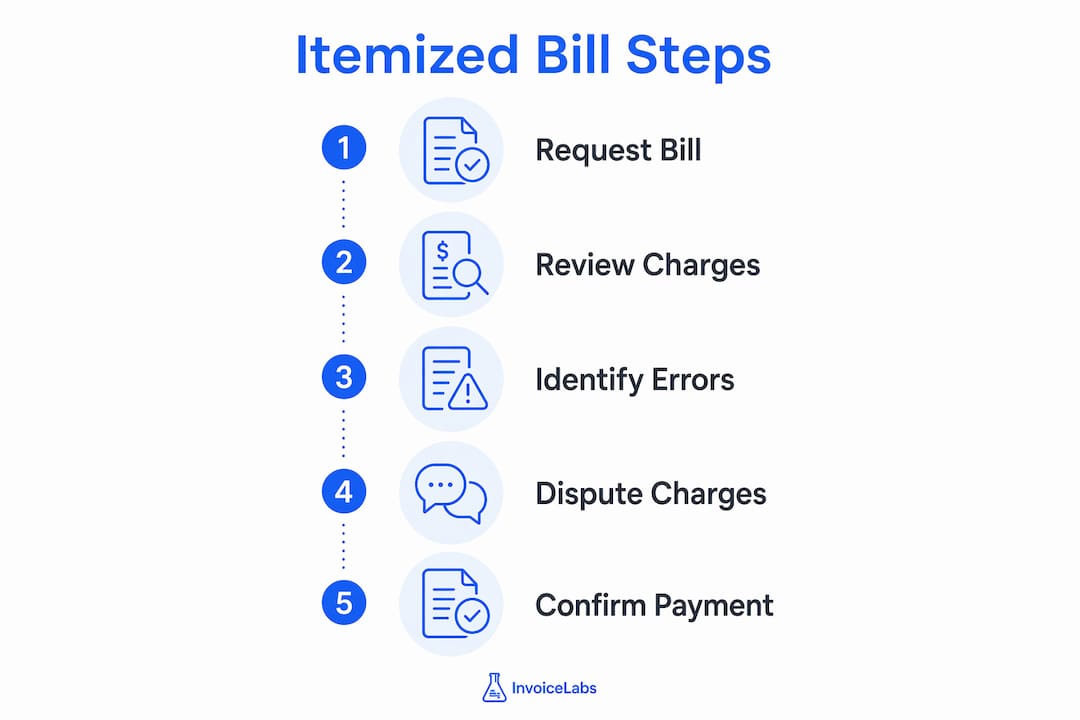
Requesting an itemized bill is straightforward. Call the hospital or provider’s billing department and ask specifically for an itemized statement or itemized bill. You have the right to receive one under federal law. If the billing office pushes back or offers only a summary, reference the No Surprises Act directly.
Once you have it, here is how to work through it:
- Match line items to your EOB. Every charge on your bill should correspond to a line on your EOB. Charges your insurer never received are a red flag.
- Look up CPT and HCPCS codes. The CMS website and other public databases let you verify what each code represents. A code for a service you did not receive is grounds for dispute.
- Flag duplicates and date mismatches. The same charge appearing twice, or a charge dated outside your visit window, is a common error worth challenging.
- Contact the billing department in writing. When disputing a charge, put your request in writing and keep copies. Ask for a corrected bill before paying.
- Negotiate from the itemized detail. Hospitals often have financial assistance programs or will reduce charges for uninsured or underinsured patients. You cannot negotiate effectively without knowing which specific charges are inflated.
The IRS also recommends keeping financial records for at least three years — and medical bills with itemized detail are worth holding onto for tax purposes if you claim a medical expense deduction.
A payment processing cost audit follows the same logic: you cannot identify what to dispute or renegotiate until you can see every charge broken out individually.
Pro Tip: Ask for your itemized bill before your insurance processes the claim. Catching errors at that stage is faster and less complicated than disputing after payment has been applied.
Key Takeaways
An itemized bill gives you the line-by-line detail needed to verify charges, catch errors, and negotiate effectively — whether you are reviewing a hospital statement or a contractor invoice.
| Point | Details |
|---|---|
| Definition | An itemized bill lists every charge separately with quantity, date, and cost, unlike a summary bill showing only a total. |
| Legal right in healthcare | Federal law, including the No Surprises Act, requires providers to supply an itemized bill upon request. |
| Error detection | Duplicate charges and unbilled services only surface when every line item is visible, not in a lump-sum total. |
| EOB vs. itemized bill | Your Explanation of Benefits comes from your insurer; the itemized bill comes from your provider — you need both to verify charges. |
| Billing confusion is widespread | Nearly 40% of Americans reported confusion over medical bills in a 2022 survey, underscoring the value of detailed statements. |
If you send bills yourself, the same transparency you want as a consumer is what your clients expect from you. Invoicelabs lets you generate a detailed invoice in under 30 seconds, with real-time tax calculations, line-item breakdowns, and instant delivery — so every charge is clear before questions arise.
Recommended
Send your next invoice in seconds
Create professional invoices, track payments and get paid faster — free to start.